Rising demand for e-scooter rental in London - TfL

 Getty Images
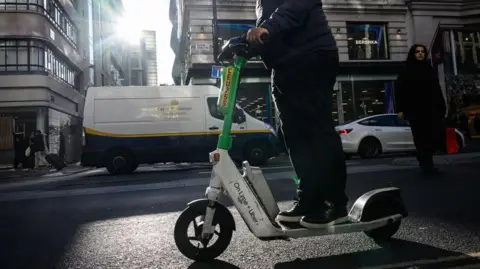
Demand for rental e-scooters grew by more than 50% in 2025 compared with 2024, according to new Transport for London (TfL) data.
According to its report, more than two million e-scooter trips were made between September 2024 and September 2025, up on 1.3 million in the same period the year prior.
The report analysed data from the capital's trial e-scooter scheme run by TfL and London Councils with operators Voi and Lime.
The scheme is the only legal way to drive electric scooters on London's roads.
 NFB
NFBHelen Sharp, from TfL, said the next phase of the trial would "play a crucial role in informing future legislation and policy" on e-scooters.
The trial, which has been running for four years, has expanded significantly during this time with rental e-scooters now operating in a third of all boroughs.
Islington is one that is not participating in the trial. Its executive member for environment, air quality, and transport, Rowena Champion, said the borough had "concerns about potentially negative safety and accessibility impacts".
According to TfL's data, 0.0007% of rental e-scooter trips resulted in serious injury. There have been no fatalities during the trial.
'Trip hazards'
The report said 95% of trips on the e-scooters ended in designated parking bays and that the data was "evidence that rental e-scooters can be effectively integrated into the capital's transport network".
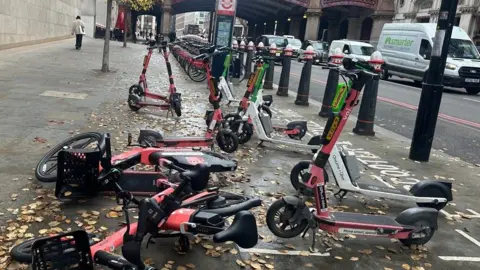
However Sarah Gayton from the National Federation of the Blind (NFB) said rental e‑scooters were "disruptive and dangerous" to pedestrians.
She pointed out that, despite assurances made in 2021 by London's walking and cycling commissioner Will Norman - who told BBC London that e‑scooter parking bays would not be placed on pavements - the reality had not matched the promise.
"Back then there were parking bays on pavements, and there are still parking bays on pavements. What was promised was not reality," Gayton said.
She added that while some bays were now off the pavement, rental e‑scooters could still be knocked over and create trip hazards over the kerb and onto pedestrian areas.
"Regardless of the parking bays, e‑scooters are still being found in hazardous locations, which are not safe for blind and partially sighted people," she said.
Commenting on the report's findings, Norman said the rental e-scooter trial had helped "boost sustainable travel" in the capital.
Christina Moe Gjerde, from Voi, said the rise in demand should prompt the government to introduce permanent legislation and licencing for the riding of e-scooters.
Listen to the best of BBC Radio London on Sounds and follow BBC London on Facebook, X and Instagram. Send your story ideas to hello.bbclondon@bbc.co.uk