Oxford Street to ban traffic by 'end of summer'

 Mayor of London
The mayor of London says he has instructed his team to "work at pace" to ban traffic from Oxford Street "as quickly as possible".
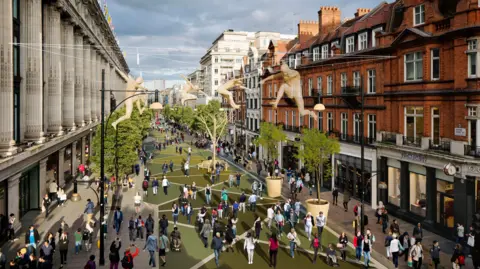
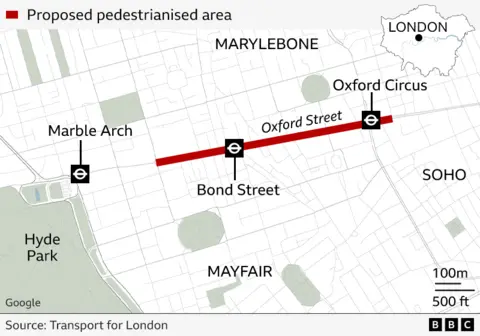
The central London shopping street will be pedestrianised from Orchard Street to Great Portland Street under plans approved last week.
Sir Sadiq Khan said work to create a traffic-free zone could start straight away, with the aim of completing the scheme by the end of the summer.
Westminster City Council's Conservatives accused the mayor of "pressing on regardless" with the plans despite strong opposition. The scheme was approved only after Sir Sadiq obtained government permission to assume planning powers, following the council's rejection of the proposals.
Under the plans, the west stretch of Oxford Street will be closed to private motorised vehicles, buses, taxis and private hire vehicles, cycles, scooters and pedicabs.
The zone will include Ikea at one end and Selfridge's at the other end.
Once the changes are made, the mayor wants to create a new events space from this year.
There are also plans for more trees and greenery and new rest areas for people to sit down and for children to play.
Sir Sadiq said safety would be a "priority", with CCTV, extra signage and lighting to be installed.
'World-class events'
"Following strong support from Londoners and businesses, I've asked the team to move at pace with plans to pedestrianise Oxford Street this summer so we can deliver a vibrant, world-class, accessible destination," Sir Sadiq said.
"I want this stretch of Oxford Street to be transformed into a pedestrian plaza – a space designed to host world-class events, from sport to culture and fashion, as well as exciting new retail and leisure experiences," he added.
The scheme was designed to ensure emergency services could access the street at all times and servicing vehicles could enter the traffic-free area overnight, City Hall said.
Alex Williams, chief customer and strategy officer at Transport for London, said: "In the coming months, we'll work to implement changes to the roads around Oxford Street to allow for proposed bus changes to be implemented.
"We'll also begin work along Oxford Street to prepare the road for pedestrianisation."
Sir Sadiq himself approved the scheme following the creation of a mayoral development corporation (MDC), a statutory body set up to deliver regeneration projects.
The MDC was permitted by the current government and required new legislation to pass planning powers to the mayor that were previously held by the local authority.
Westminster City Council previously turned down the pedestrianisation plans, citing opposition from local residents.
Leader of the Conservative group at Westminster City Council Paul Swaddle said: "The mayor just isn't listening. He's got his plan, he got his vanity project, and he's just pressing on regardless. So it doesn't matter if people object - which they did.
"The consultation was fudged... and people are really concerned here locally."
Swaddle said Sir Sadiq had "totally abused" the MDC system by using it to create the traffic-free scheme.
The mayor said 2,700 people responded to a public consultation, with the majority of respondents in favour of the pedestrianisation plans.
'Mayor's legacy'
BBC London's transport and environment correspondent said the idea of pedestrianising Oxford Street had "thwarted each London mayor so far, as it lies in two boroughs amongst marginal seats".
He said local opposition had managed to stop the plans, but now Sir Sadiq had found a way round with the creation of the MDC.
"Experts say doing that in a city centre is unprecedented as it is usually reserved for brownfield sites like the Olympic Park or Old Oak Common. Even local Labour politicians have called it 'dangerous for democracy'," he said.
"The mayor seems to be disregarding that, arguing the end result of no traffic outweighs any local opposition.
"He does not think local people should be able to influence - as he puts it - national regeneration schemes so the strategic authority in this case has trumped local democracy.
"The mayor wants Oxford Street to be a physical legacy of his administration. It looks like he will get that."
Listen to the best of BBC Radio London on Sounds and follow BBC London on Facebook, X and Instagram. Send your story ideas to hello.bbclondon@bbc.co.uk