Emirates with 400 passengers takes off from Dubai for Dublin

 PA Media
An Emirates has departed Dubai for Dublin, carrying passengers whose flights were cancelled at the weekend.
The United States-Israeli attacks on Iran have led to the closure of nearly all airspace in the Middle East.
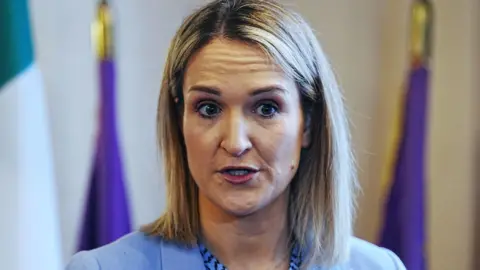
Irish Foreign Affairs Minister Helen McEntee said there would be more than 400 people on the flight.
McEntee said the focus for airlines was their customers and people stuck in transit.
She added that the Irish government was working to operate charter flights to the Republic of Ireland from Oman as she said no country was able to arrange charter flights from Dubai or Abu Dhabi
It is about a six-to-eight bus journey to Oman from those cities and passengers will be transported by bus.
"We are basing everything that we do and our embassies on the ground are basing everything that they do on advice that has been provided. The airlines themselves, they are of course keeping in regular contact to make sure that it is safe to carry out these flights," she told Newstalk radio station.
Earlier, McEntee said the Emirates flight was a "positive development", and that the department was "in close touch with the airline".
Allow X content?
Dublin Airport Authority (DAA), which operates Dublin Airport, confirmed Emirates planned to operate two flights on Wednesday between Dublin and Dubai.
The first is on its way from Dublin to Dubai and is due to land at 00:45 Dubai time on Thursday.
The other has taken off from Dubai and is due to land in Dublin at about 22:00 Irish time.
Graeme McQueen, from the DAA, said it was currently unclear how many passengers would be on the flights but the expectation was "that it will be a small number only on both".
McEntee previously asked for "everyone's patience as our most vulnerable citizens are contacted in this first phase of our response to this crisis".
The minister said the Irish government would "continue to offer consular assistance to all citizens in the region".
"All citizens should register with the appropriate embassy if they have not already done so and continue to follow our embassy social media accounts for the latest updates," he said.
How many Irish are in the Middle East?
So far 25,000 Irish citizens in the region have registered with the Department of Foreign Affairs - 2,000 of them have said they want to leave.
"We're looking at one of the largest planes that we can and that's probably up to about 280 people," she said.
"So I appreciate when you talk about the thousands who are there, that is a fraction of the number of people that may want to get home at the same time."
Conflict has spread across the Middle East following US and Israeli strikes on Iran, in which the country's supreme leader was killed.
Tehran has retaliated with a wave of attacks across the region.
'Incredibly difficult few days'
Meanwhile, thousands of British nationals stranded in the Middle East are also returning home on Wednesday as airlines increase their flights from the region.
British citizens stuck in the Middle East have told the BBC there has been a lack of information about available routes to travel home.
Foreign Secretary Yvette Cooper told MPs on Tuesday that the "safety and security" of British nationals were a "top priority".
She told the House of Commons that a government charter flight would fly from Muscat in Oman in the coming days, prioritising vulnerable nationals.
The government is also working with airlines on increasing capacity out of Muscat for British nationals, she said, adding that Britons "must wait to be contacted by the Foreign Office regarding these options".
Sandra Corkin, managing director of Oasis Travel, said that the company were dealing with dozens of holidaymakers affected by the conflict.
Corkin told the BBC's Good Morning Ulster programme most of its passengers were actually further away in places like Australia or New Zealand but that their flights were connecting through the Middle East.
She said the first plan had been to get people onto direct flights through London or Europe but that became increasingly difficult.
She said some passengers had flown to China and then to London, but it had been an "incredibly difficult few days".