On patrol with armed officers policing the Humber

 BBC
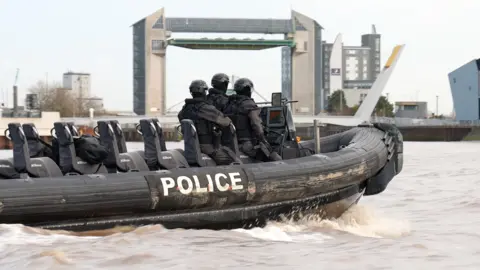
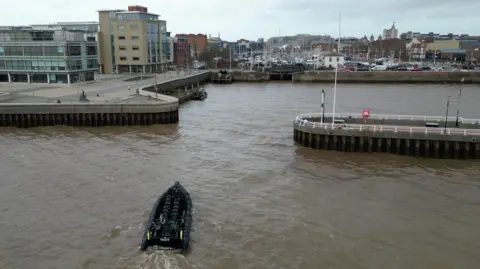
BBCAlong the Humber Estuary, the sight of ferries, tankers and trawlers forms part of the everyday backdrop. But recently, something more unusual has been drawing attention from people walking the banks: small, black police boats cutting across the water, crewed by officers carrying firearms.
Photos and posts began appearing online. People asked why armed officers were patrolling the estuary at all — and what situations could require weapons on the water.
To find out, I joined Humberside Police's Marine Unit on a cold winter morning at Hull Marina.
The sun is barely up when Insp Matt Stringer, PC Emma Beck and PC Mark Thompson meet me on the pontoon, buckling on life jackets beside two jet‑black police boats.
One of the vessels is being prepared by balaclava‑clad firearms officers whose identities must remain protected. The other would take us into the Humber.
These specialist boats, capable of more than 50 knots, are designed for fast movement along one of the UK's busiest inland waterways — and for responding to the unexpected.
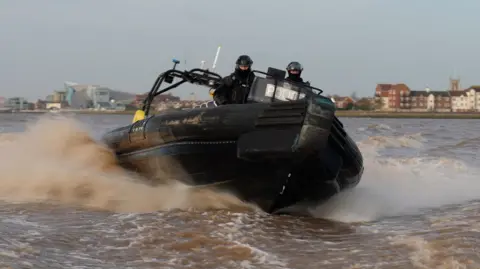
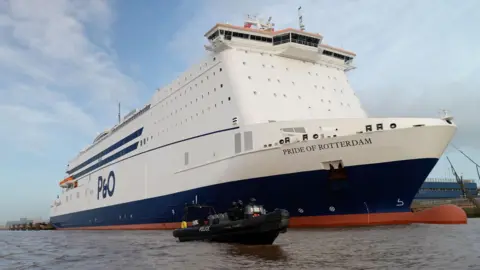
We slip past The Deep and the Siemens Gamesa turbine facility, heading east towards King George Dock. Ahead of us, the armed patrol boat appeared almost toy‑like beside the towering hull of a ferry.
Despite the occasional major incident — from drugs trafficking to modern slavery — the Marine Unit says its day‑to‑day work is quieter than many imagine.
Officers check in with commercial operators, liaise with vessels mid‑river and speak to people on the bankside paths who approach them with questions.
By 09:00 GMT, we had spoken to the crew of a vessel in the middle of the estuary. By 10:00, the boat was cutting across the Humber's brown, churned-up chop towards Barrow Haven on the south bank.
During the journey, Thompson describes one of the defining moments of his 29‑year career.
In March 2025, he was among the first officers to board the Stena Immaculate and the MV Solong after the tankers collided in the North Sea — an incident that later led to the conviction of the Solong's captain, Vladimir Motin.
"It was probably one of the scariest things I've ever done," he says. "The vessel was still steaming from the heat. The gangway had burned away in the fire, so we had to rig a pilot ladder and climb about 11m just to get on board."
Once inside, he retrieved CCTV, the captain's log and bridge data.
"We train for the worst‑case scenario — and on that day the training proved invaluable."
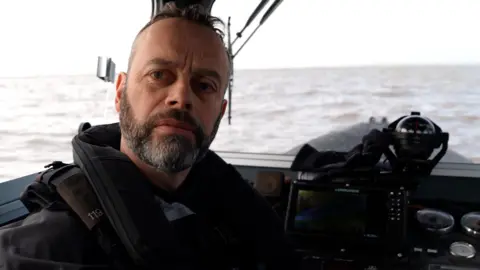
Not every shift looks like that one. Beck, steering the boat as spray lashes the cabin windows, explains how the unit's tasking varies.
"We're predominantly a counter‑terrorism team. However, we also police any criminality from drugs to people trafficking or firearms across the Humberside area.
"Last week, we were on the water and we deployed armed officers in support of a firearms operation.
"The criminality that can happen on the waterways can be from really low level up to quite serious criminality that requires higher-end tactics."
Some patrols are routine. Others are driven by intelligence or by concerns raised through public reporting schemes such as Project Kraken.
"We had an incident last year on the waterways where we supported in the recovery of 450kg of Class A controlled drugs," Stringer adds.
The Marine Unit also provides counter‑terrorism support across the whole of Yorkshire.
Humberside Police says it has had marine officers for more than 40 years and "the evolving nature of coastal crime has seen increases in demand".
It adds the "new collaborative proactive policing with armed officers" began on 11 February.
As we pass beneath the Humber Bridge, the wind picks up and the river broadens.
By 11:00, we are heading back towards Hull.
The presence of firearms on small patrol boats is unusual enough that the force has been fielding questions from residents.
Stringer says it is important people understand the reasoning.
"Out here we're quite isolated, even though we're very close to Hull, to Grimsby, to Scunthorpe," he says.
"We have to be able to deal with any threats or risks on the waterways."
Civil liberties groups have historically raised questions about visible armed policing, particularly around proportionality, public consent and transparency on decision‑making.
Police officers in Great Britain do not routinely carry firearms.
Only specially trained Authorised Firearms Officers are permitted to do so, and their deployment follows strict national rules set out by the College of Policing and approved by the Home Office.
Decisions to deploy armed officers rest with a force's Chief Constable and are based on threat assessments.
Jonathan Evison, the Humberside Police and Crime Commissioner, said the unit contributed to keeping communities safe.
He added: "I have oversight of the collaborative work this unit undertakes with other forces across Yorkshire and Humber and routinely hear of their successes and contribution both regionally and at times nationally with their specialist support."
Just after midday, the patrol boats draw curious glances as they return through the lock gates at Hull Marina. Stringer stops to talk to several passers‑by who ask about the weapons and the unit's role.
Today has been quiet. But on busier days, this small team may deal with anything from antisocial jet‑skiers to serious maritime incidents offshore.
For an estuary shaped by centuries of maritime trade and industry, policing the Humber remains a key priority with specialist skills needed.
Listen to highlights from Hull and East Yorkshire or Lincolnshire on BBC Sounds, watch the latest episode of Look North or tell us about a story you think we should be covering here.
Download the BBC News app from the App Store for iPhone and iPad or Google Play for Android devices