What you need to know about the verdict against South Korea's impeached president

 Getty Images
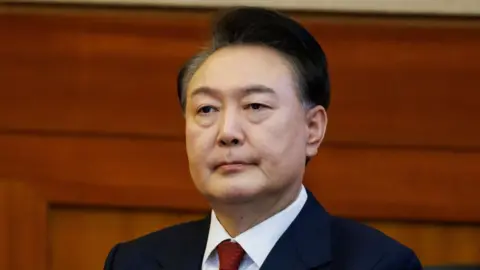
South Korea's ex-president Yoon Suk Yeol has been jailed for life for leading an insurrection, a little over a year after he tried imposing military rule.
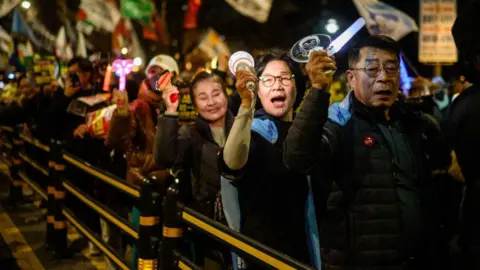
His short-lived decree threw South Korea into turmoil, deeply divided the country and handed the opposition a landslide victory six months later.
Yoon, 65, has already been handed a five-year jail term for abuse of power and obstructing his own arrest. He also faces two more trials. But today's verdict involved the most serious charge - leading an insurrection.
Insurrection
Insurrection refers to the act of revolting against or overthrowing an established government or authority of a nation state, often by violent means.
Under South Korea's constitution, sitting presidents are immune from criminal prosecution, except when the charge is insurrection or treason.
On Thursday, a Seoul court ruled that Yoon's actions on 3 December 2024 – in particular, deploying military troops to seal off the National Assembly and ordering the arrest of politicians – were acts to subvert the constitution.
"The court finds that the intention was to paralyse the assembly for a considerable period," presiding judge Ji Gwi-yeon said while convicting Yoon as the "chief insurrectionist".
Prosecutors sought the death penalty, describing Yoon as "unrepentant". They argued that a lesser sentence may not send a strong enough message to those who may wish to attempt something similar.
Yoon had earlier claimed he declared martial law to protect the country from "anti-state" forces that sympathised with North Korea. But in the weeks that followed it became apparent that he was driven by other challenges: he had become a lame-duck president facing plummeting ratings, scandals and an opposition that was threatening to investigate his wife over corruption allegations.
But even during his trial, he continued defending the martial law order, calling it "a measure to protect the freedom and sovereignty of the people and to preserve the nation and its constitution".
 AFP via Getty Images
This isn't the first time a former South Korean leader has been convicted for his role in an insurrection.
Chun Doo-hwan, who ruled South Korea in the 1980s as a military dictator, was sentenced to death for leading an insurrection, though this was later reduced to life imprisonment. His ally and successor Roh Tae-woo was handed a lengthy jail term for his part in it. Both were eventually pardoned.
Prosecutors have argued, however, that Yoon's 2024 martial law attempt "tarnished the nation's dignity far more severely" than the military coup Chun and Roh staged in 1979.
Law professor Lim Ji-bong told the BBC ahead of the verdict that he expects the judge tohand down a life sentence to "avoid making Yoon a martyr". A death sentence carries political risk as it may further alienate Yoon's supporters and deepen chaos in the country, he said.
Even if he had been handed the death sentence, it would, in effect, be life imprisonment because South Korea has not executed anyone on death row since December 1997.
US-based lawyer and Korea expert Christopher Jumin Lee believes Yoon will ultimately be pardoned, as Chun and Roh were.
"It's a customary thing about Korean politics," Lee said. "Whatever the sentence, it's just a symbolic acknowledgement of how severe the crime is."
Obstruction of justice
In January, Yoon was found guilty of obstruction of justice by evading arrest; abuse of power by not convening a cabinet meeting before his martial law declaration; and falsifying official documents.
Prosecutors accused him of using state institutions "for personal purposes" to conceal wrongdoing and undermine constitutional checks and balances.
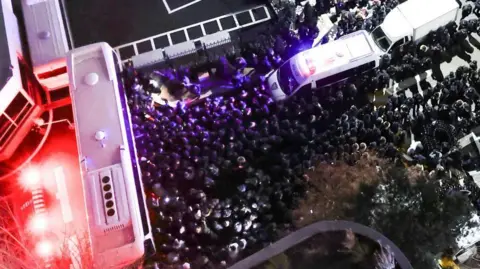
In January last year, it took some 3,000 police officers, over two attempts, to finally take Yoon into custody for questioning over the insurrection charge.
Yoon had mobilised a large group of security officers who formed a human wall inside his residence to block the arrest - a move that a special prosecutor investigating the charge said was unprecedented.
Yoon, meanwhile, argued the Corruption Investigation Office that attempted to arrest him lacked jurisdiction to investigate insurrection charges.
The chaos surrounding the arrest, and the earlier failed attempt, "demonstrated apparent lawlessness by Yoon, [his] conservative party, and South Korea's domestic security institutions", said Mason Richey, an associate professor at Seoul's Hankuk University of Foreign Studies.
"The obstruction of justice trial is a way to ensure accountability for these," he said.
 Reuters
Aiding an enemy state
Prosecutors have also alleged that Yoon tried to provoke North Korea into attacking the South so as to justify his martial law declaration.
In putting forward this charge, the prosecution relied on evidence found on former military intelligence chief Yeo In-hyung's phone that contained words suggesting potential provocations. They also cited a memo which appeared to push for a move to "create an unstable situation or seize an arising opportunity".
This trial, which opened in January, will look at whether Yoon ordered drone flights into the North to induce military conflict between the Koreas, among other things.
Yeo and Yoon's former defence minister Kim Yong-hyun have also been indicted on the same charge.
Other charges
Yoon has also been accused of perjury, for when he testified during former prime minister Han Duck-soo's trial last year on charges of aiding the insurrection.
Prosecutors allege that Yoon falsely testified by claiming he had long planned to hold a cabinet meeting before declaring martial law. Investigators said Yoon had no such plan and only convened a meeting at Han's urging.
Apart from charges related to his martial law attempt, Yoon has also been indicted in a series of other cases.
He is among 33 people charged for allegedly obstructing an investigation into the death of a young marine officer in 2023, and for aiding the suspect in this case.
He has also been charged for meddling in the 2022 presidential elections and making false statements during his campaign.