The house where every day is a crime scene

 University of Worcester
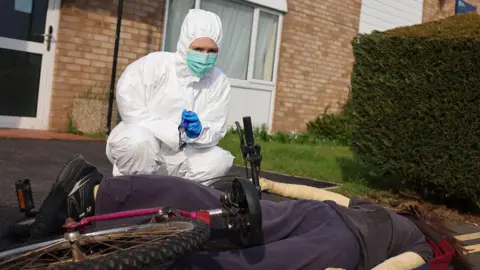
Outside a semi-detached property on the fringes of a city, what appears to be a woman's body lies face down in the road.
The surrounding area is cordoned off with yellow tape as white-suited investigators carefully examine an abandoned SUV, its doors left open as if somebody fled the scene in hurry.
If you were to investigate the house further, just off Hylton Road in Worcester, you would discover packages of narcotics, burner phones and bones jutting from a vegetable patch.
But despite appearances, no crime has taken place. The body is that of a dummy and the scene a simulation, reimagined by industry experts to train forensics students at the University of Worcester.
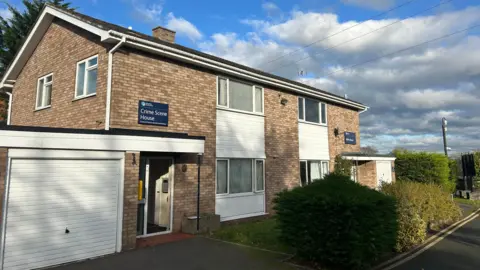
The BBC's Secret Worcestershire series has suited up to analyse what is going on behind the curtains at Crime Scene House.
"What we try and do is set up crime scenes very similar to ones we've worked on in reality," explained senior lecturer in Forensic and Applied Biology Keith Unwin.
He is also a practising forensic scientist with decades of experience in the field.
"We're falling back on our knowledge and our experience of crimes that we've been to and we've worked on in order to set up the most realistic crime scenes we can."
Crime Scene House looks unassuming enough from the outside, with a double garage and neatly-maintained front lawn.
It lies at the edge of the university's St John's campus, next door to a building used by student paramedics.
But poke around the garden and you will see a jaw-bone in the undergrowth in an area used by students to analyse bones.
'Crime scenes are complicated'
Third-year student Aliya Iqbal explains the scenario she is working on. An early morning hit and run, with the vehicle's owner having reported their car stolen.
Sterilised water is used to take blood swabs from the crash scene, and a brush to check the car for fingerprints.
Fellow student Anna Howard said: "Typically, we wouldn't be the first responders. Police would get to the scene first and decide if they need forensics here."
The students take photographs, painstakingly logging each one. They bag a loose cigarette and note a smashed brake light and a number plate spattered with blood.
Student Ella Sumnall explained even the patterns formed by blood could be used to make deductions.
"When blood is airborne it tends to form a ball, and when it hits a surface like that it splatters it in a circular form," she said.
"It also has little dots around it which means it has come at speed, which would be indicative of a hit and run."
Unwin said students needed to "think outside the box" but also apply logic. Many go on to careers in labs or work for the police.
"If we can get them to do these crime scenes, they can learn those skills and take them out into the real world," he added.
"In reality, you have to think logically throughout the whole process and people will come back and argue the evidence so you have to think about all aspects.
"That does make crime scenes complicated."
Follow BBC Hereford & Worcester on BBC Sounds, Facebook, X and Instagram.