More work, no funding - paediatrics under pressure

 BBC
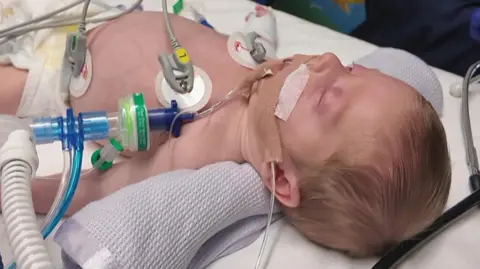
BBCWhen I met ten-week-old Carson he was struggling to breathe.
Born premature, at the Royal Hampshire County Hospital in Winchester, he was tiny.
It was suspected that he had picked up an infection which his young lungs could not cope with.
The team of doctors and nurses had stabilised him but Carson needed an extra level of care. So they called in the experts, and after a short time in intensive care he recovered.
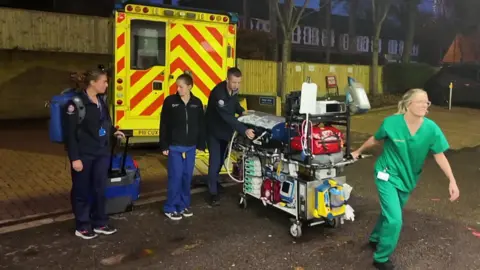
It is mid-winter and I am shadowing the Southampton Oxford Retrieval Team (SORT).
The team of specialists is on call 24 hours a day to collect the most poorly children and babies and take them to intensive care, supporting 27 hospitals across the south of England.
I am with them in Southampton when the call comes in that baby Carson's life is in danger.
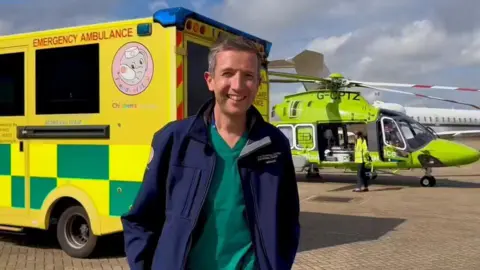
There is a problem. There are no beds in the paediatric intensive care unit, but the team get on the road anyway.
They are lead by Michael Griksaitis, a consultant paediatric intensivist at University Hospital Southampton: "We dispatch to go and help the child whether there is a bed or not because actually it is irrelevant.
"The child still needs critical care, so bed or not the transport team would go out."
In winter, this is a situation they find themselves in on most days.
The BBC has learned that despite rising demand on these services, this year SORT will be expected to collect potentially hundreds more children who do not need critical care, but still require transport by ambulance to hospitals.
This will involve picking up potentially hundreds more children who are less sick, known as level 2 – those who need a high-dependency hospital bed – but with no more resources.
All 13 retrieval teams UK-wide will be asked to increase their workload despite already being at capacity and without extra funding.
"Nowhere in our business case, in our funding, in our set up, were we ever planned to deal with that extra workload," Griksaitis says.
"When that happens, because it is happening, the demand on the service will increase because we'll have to move even more children to a high dependency unit."
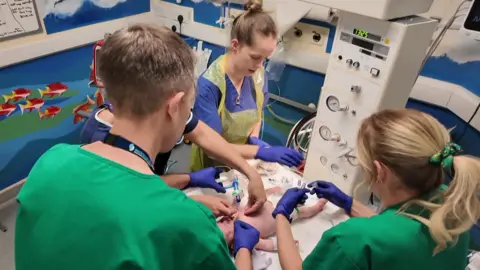
Most hospitals don't have a Paediatric Intensive Care Unit (PICU), so the SORT team supports the 27 regional hospitals that call for help when they have done all they can to care for a child.
In winter, three call outs like this every day are common.
The team estimates that to meet extra demands this year it would need an additional ambulance and staff, costing about £2m, and that would be needed for each team UK wide.
"I think what keeps me awake at night currently is the demand that is going to be put on the transport services potentially soon, without any increase in the resources to deliver that, and that's going to be hard," Griksaitis explains.
An NHS spokesperson said: "Paediatric critical care transport teams provide high-quality and safe clinical care to all critically ill and injured children requiring inter-hospital transport, with access for the sickest children prioritised according to clinical need, and we will be monitoring transport levels closely in line with demand."
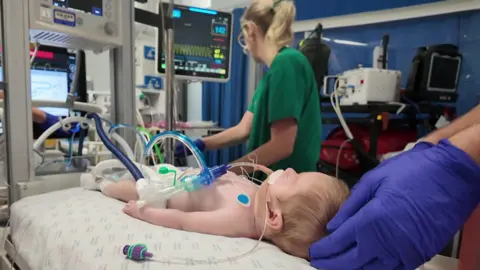
Carson is taken from Winchester to University Hospital Southampton's PICU.
The round trip for the SORT team takes two hours, and there is good news: a bed for him has been found.
Griksaitis says the team is "going above our patient numbers because we can't turn away critically ill children," and explains that the hospital has "obviously managed to do something while I've been gone".
The pressure is so great in winter - there have been times when every PICU in the country has been full.
The Southampton unit has a total of 16 beds, but on the day I film it is fitting in 18 patients.
Griksaitis says that is thanks to the staff: "Nurses have come in on days off. Nurse have given up their time to come and allow us to open an extra bed.
"Everyone wants to help children, so people will sacrifice their own time at home to do that."
In the safest place for him, Carson underwent a range of investigations.
It was confirmed that he had bronchiolitis and he spent a short time in intensive care.
He was soon back home again.
You can follow BBC Hampshire & Isle of Wight on Facebook, X, or Instagram.