'Buying second hand clothes is a good trend'

 BBC
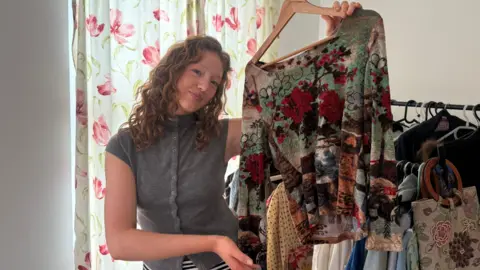
BBCMore young people in Guernsey are turning their backs on fast fashion and buying clothes second hand, according to charity shops.
The fashion industry is considered responsible for up to 8% of global greenhouse gas emissions, according to the UN.
Fast fashion is defined as the quick turnover of fashion trends, leading to companies consistently releasing new lines of affordable mass-produced clothing.
Some young islanders say they are choosing to buy clothes second hand as an alternative to fast fashion.
Evie Shackleton, 21, said: "I think kids are realising it is cool to shop second hand. I do not think it is just a trend, I think, if anything, it is a good trend."
Evie said she had always bought clothes from charity shops but had noticed an increase in people her age also buying second hand.
"There is no better way to get these individual, cool pieces," she said. "The pieces I buy second hand are the ones that stay longer in my collection."
Evie said her friends enjoyed going to charity shops with her.
"It is very cost effective and in Guernsey there is not a lot to do - it is a very creative thing," she said.
Evie said at one of the shops she visited, the employees told her more young people and children had begun buying clothing from them.
As well as clothing, she has also bought room decorations, jewellery and a guitar second hand.
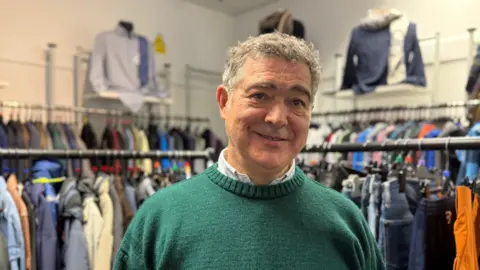
Les Bourgs Hospice is one of the island charities which gains revenue from its shops.
Chief executive Rob Jones said the shops brought in £960,000 last year and were one of the main ways it funded palliative care.
The hospice, unlike its UK counterparts, is funded solely by charity as it does not receive funding from the States of Guernsey.
Jones said: "We are starting to see more young people come in, I think they are appreciating the quality you can buy - you are not paying any more than you would pay in fast fashion.
"The integrity is there, you know it is something that has been recycled, is of great quality and it has got a good brand name on it."
He added how he thought the uptake was due to young islanders being more "conscious of recycling".
"Younger people are much more aware of the challenges at the moment on the planet - I think it is now something taught in schools and through social media."
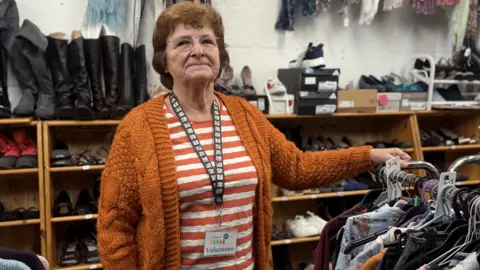
Sally Ogier, a volunteer at Citizens Advice charity shop since 2019, said the shop had seen a rise in young customers.
Ogier credited the increase to special events, such as hen parties, bringing attention to the shop.
"You get really good things, you get them at a very good price and in today's budgeting it is very difficult."
She added the charity shop often received unused clothing, some still with tags on them.
Douglas Button, waste minimisation and sustainability officer at Guernsey Waste, also urged people to buy second hand.
He said: "Think before you buy - do you need this item of clothing? Is there not a second hand item of the same quality?"
"The more clothes the population buys, the more waste we end up producing. Inadvertently, [fast fashion] increases the amount of textile wastage on island.
"There are emissions that are spent getting things to and off this island - the more we bring in, we have got to bring the same amount off at some stage."
Button said there was no way to know how much clothing from Guernsey went into landfill, due to textiles being disposed of with the general waste.
He encouraged people to donate good quality clothing to charity shops and clothing banks across the island.
A spokesperson for the Salvation Army, which runs the clothing banks across the island, said: "Each year, we collect several hundred tonnes of donations in Guernsey.
"We work hard to ensure as much as possible is reused, whether sold in our shops or by redistribution partners, or given directly to people in need."
Follow BBC Guernsey on X and Facebook and Instagram. Send your story ideas to channel.islands@bbc.co.uk.