Scotland needs new approach to deal with feral pigs, report says

 Getty Images
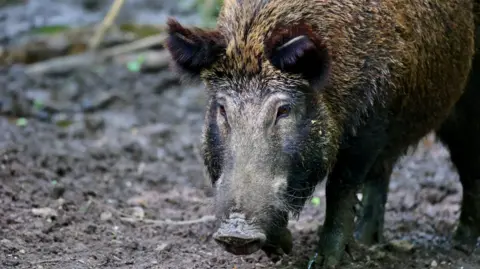
Researchers say Scotland needs to take a new approach to managing its "expanding" populations of feral pigs.
The animals include escapees from farms and pigs illegally released into the wild, with the largest numbers found in the Highlands and Dumfries and Galloway.
A report by King's College London and Czech Academy of Sciences suggests the current policy is "fragmented" and has led to tensions between landowners who view them as an "unruly nuisance" and those who want the pigs left to roam free.
The Scottish government said it was continuing to assess whether further coordination or monitoring measures are needed.
Under current policy, individual land managers are primarily responsible for controlling feral pig populations, and should work in partnership with local communities.
Where feral pigs are present, land managers are encouraged to control their numbers to manage their impacts on agriculture and the environment.
They are not a protected species and they can be shot.
NatureScot and Forestry and Land Scotland have best practice advice on controlling the pigs. This includes trapping and shooting them.
Disease risk
But the researchers said a national forum should be established bringing together all sides of the debate on what should be done with the animals.
They also claimed improved monitoring and "strengthened biosecurity" is needed to prevent any potential spread of disease from feral pigs to domestic animals.
They said their report highlighted tensions between Scotland's rewilding ambitions and concerns over agricultural damage and potential disease risk.
The researchers described current governance arrangements as "fragmented and reactive".
Their report drew on research done in the Highlands' Great Glen and continental Europe.
Toryn Whitehead, a PhD researcher at King's College London, said the tensions around controls included disagreement over what to call the animals.
He said: "They are officially called feral pigs, and I found in my research that many people locally do call them that.
"But there are also a substantial number of people locally who call them wild boar.
"So what they are and their precise identity is kind of highly contested."
Previous research forecast numbers of feral pigs could rise from 1,472 today to about 2,400 by 2075 - an increase of more than 60%.
 The James Hutton Institute
The Scottish government said the illegal release of any animal posed a serious risk to their welfare, as well as impacting farmers, land owners, and surrounding communities.
A spokesperson added: "The Scottish government will continue engaging with stakeholders across sectors as we assess whether further coordination or monitoring measures are required."
Scotland's nature body, NatureScot, said it welcomed the research.
A spokesperson added: "We work closely with the pig industry, Scottish government and other agencies to coordinate action on this issue and are also working with land managers on monitoring to gain a better understanding of feral pig numbers.
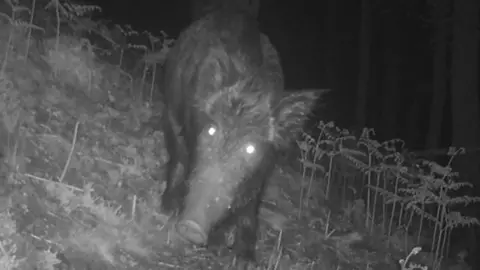
"This includes carrying out drone surveys and camera trap analysis on an ongoing basis."