Summary

  1. Analysis

    Danger is real for UK defence personnel in Middle Eastpublished at 10:02 GMT 1 March

    Jonathan Beale
    Defence correspondent

    Since yesterday morning, Iran has launched 25 waves of missile and drone attacks against targets across Israel, Bahrain, Qatar, UAE, Kuwait and Iraq.

    Yesterday, British military personnel based at a US base in Bahrain were within 200 metres (656 feet) of Iranian and missile drone strikes.

    Around 300 UK military personnel are based there, but all are reported safe and accounted for.

    Also yesterday, a British counter drone unit based in Iraq intercepted an Iranian drone that was heading towards a coalition base housing UK military personnel.

    British military personnel in Iraq, who are stationed there as part of a longstanding counter-Islamic State group mission, were within 400 metres (1312 feet) of an Iranian missile strike. All are safe and accounted for.

    UK defence sources say force protection measures at UK military facilities in the region are at their highest level.

    RAF F-35 jets and Typhoons based in Cyprus, along with a squadron of Typhoons based in Qatar, continue to fly defensive missions.

    Two Iranian missiles were fired towards Cyprus, but UK sources do not believe they were targeting the UK sovereign base at Akrotiri. A defence source said the situation remains live and the danger real.
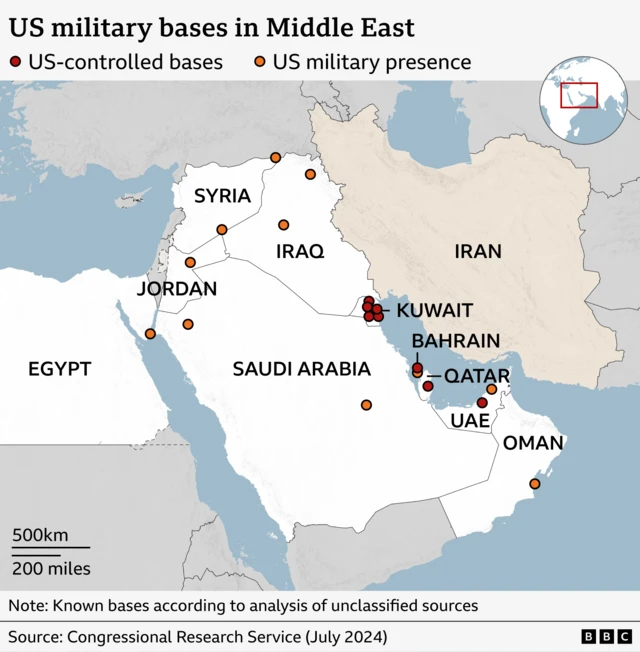
    Map showing US military bases in the Middle East. Red dots indicate US-controlled bases, while orange dots represent locations with a US military presence. Bases are marked in Egypt, Jordan, Syria, Iraq, Saudi Arabia, Kuwait, Bahrain, Qatar, the UAE and Oman. Iran is highlighted in beige for reference.
  2. New Revolutionary Guards Corp commander named in Iran - reportspublished at 09:55 GMT 1 March

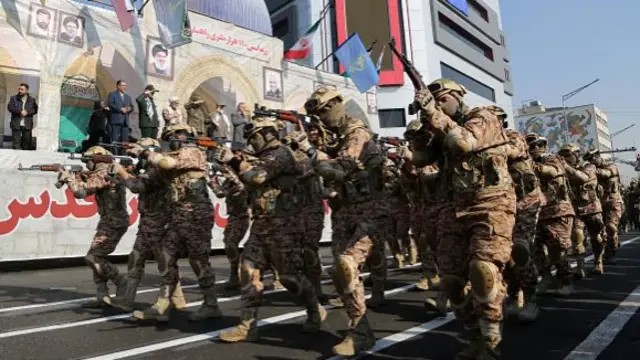
    Members of the IRGC at a march in Tehran in 2025Image source, getty

    Iran's Revolutionary Guards Corp (IRGC) has named a new commander in chief, Ahmad Vahidi, according to Reuters news agency.

    The BBC has not yet seen official confirmation that Vahidi has been appointed to the role.

    The previous commander, Gen Mohammad Pakpour, was killed in the joint Israeli-US attacks on Iran on Saturday.

    The IRGC is a major military, political and economic force in Iran, and is separate from the country's regular army.

  3. At least nine dead following pro-Iran protest at US consulate in Karachi, doctor tells BBCpublished at 09:42 GMT 1 March
    Breaking

    Usman Zahid
    BBC News, in Lahore

    A senior doctor at Civil Hospital Karachi told BBC News that nine bodies and at least 32 injured people were brought to the hospital after violent clashes with police near the United States Consulate General in Karachi.

    Hundreds of pro-Iran protesters took to the streets in Karachi, Lahore, and Islamabad following US and Israeli strikes on Iran.

    An official from the private rescue service Edhi Foundation also confirmed that they moved nine dead bodies and dozens injured to hospital. Clashes started when police tried to stop demonstrators from entering the consulate complex. Police have not yet issued an official statement on the situation.

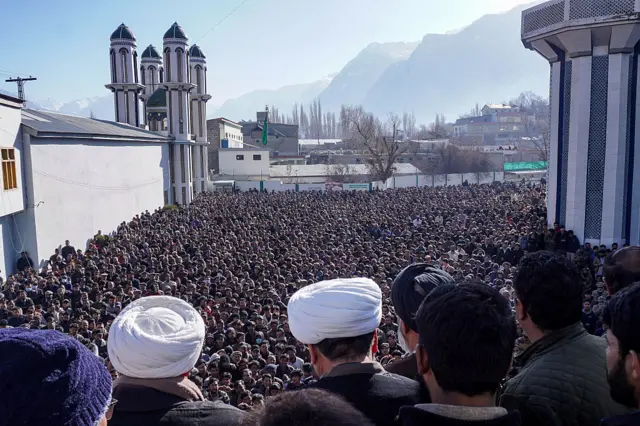
    A UN official told BBC News that a United Nations office was set on fire in Gilgit, in Pakistan-administered Gilgit-Baltistan.

    Police confirmed that a curfew was imposed in the area after hundreds of people began protesting.

    Shia organisations had announced protest rallies in several cities, including Islamabad.

    Protesters gather at US consulate in support of IranImage source, Getty Images
    Image caption,

    Protesters gather to show support for Iran in Pakistan's Gilgit-Baltistan region

  4. Loud explosions in Iran's capital Tehranpublished at 09:34 GMT 1 March
    Breaking

    Ghoncheh Habibiazad
    Senior reporter, BBC Persian

    Moments ago, two eyewitnesses from eastern and north-western Tehran have heard loud explosions in the Iranian capital.

    The source in eastern Tehran has said "the explosions were worse than yesterday's" and adds "my whole room was shaking".

    Iranian outlets have also reported on explosions in different parts of Tehran.

  5. UK's bases at risk of 'indiscriminate' attacks by Iran - Healeypublished at 09:32 GMT 1 March

    UK Defence Secretary John Healey says he's concerned that "increasingly indiscriminate attacks from Iran" are putting British personnel and British people abroad at risk.

    Speaking to the BBC's Sunday with Laura Kuenssberg programme, he says 300 British personnel were within several hundred yards of a strike on a military base in Bahrain.

    The defence secretary adds: "Make no mistake, this is a regime that he [Supreme Leader Ali Khamenei] has run for decades as a source of evil, it has murdered its own citizens, it has exported terror including to Britain."

    Healey says "no-one" will mourn Khamenei's death.

  6. Israeli media say 30 senior Iranian officials killed in strikespublished at 09:24 GMT 1 March

    Yolande Knell
    Middle East correspondent, in Jerusalem

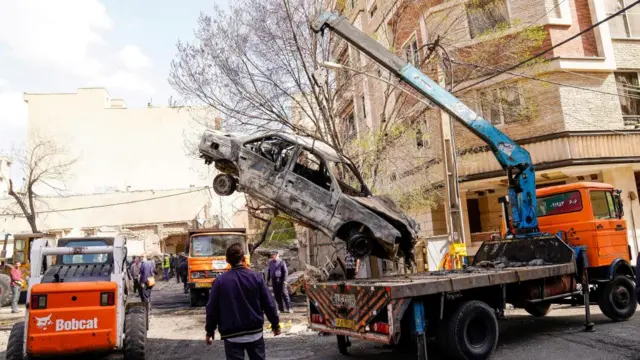
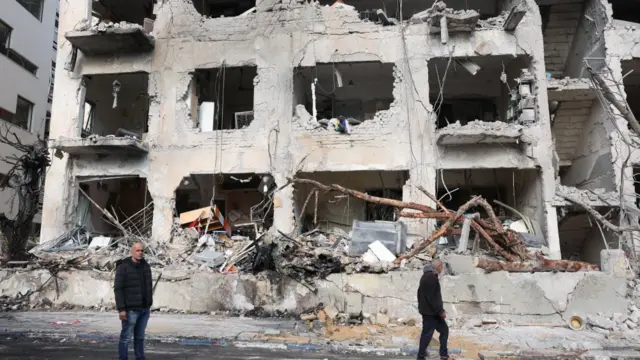
    The wreckage of a car is picked up by a crane positioned on the back of a truckImage source, ISNA/WANA/Reuters
    Image caption,

    The remains of a car following a strike in Tehran

    Israel’s Channel 12 says the country’s air force killed a total of 30 senior Iranian officials - including Iran's Supreme Leader Ali Khamenei - “in just half a minute in the opening strike” against its longstanding enemy yesterday.

    On its N12 website, journalists say Israeli political and security echelons stress that “we are only at the beginning, and we still have a campaign of at least several days ahead of us”.

    Other Israeli media highlight the extensive planning and tight co-operation between the Israeli and US military in the war so far as well as the accuracy of intelligence.

    However, defence analyst Yoav Limor cautions in Israel Hayom that gaps could soon emerge between the US and Israel.

    “Israel has all the patience and readiness to prosecute this war for several days or weeks, perhaps even longer,” he suggests, “but it is not clear that Trump has the same level of patience and cool headedness”.

    “For America, this is a war of choice, but for Israel it is a war of need,” notes veteran journalist Nahum Barnea in Yedioth Ahronoth.

    Despite US President Trump’s full support so far, he warns of the danger of US public opinion shifting against Israel.

  7. Plume of smoke rises after explosions in Tehranpublished at 09:15 GMT 1 March

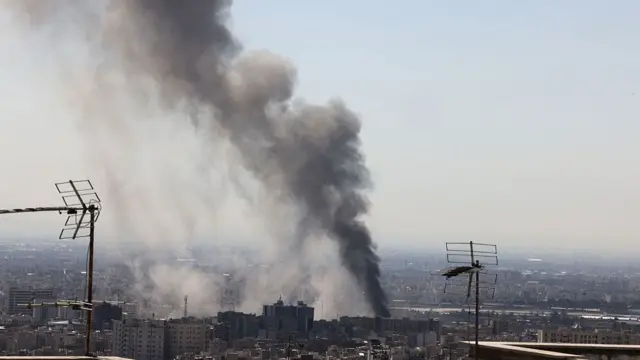
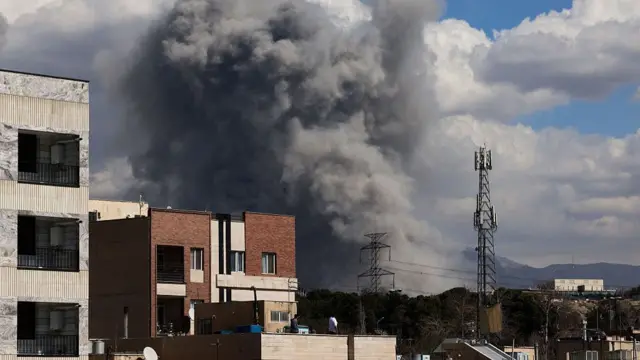
    In these new images, smoke can be seen on Tehran's skyline.

    This comes after the Israel Defense Forces said it has started a wave of strikes against targets linked to the Iranian regime in the capital.

    A plume of smoke rises following reported explosions in TehranImage source, AFP/Getty Images
    A plume of smoke rises following reported explosions in TehranImage source, AFP/Getty Images
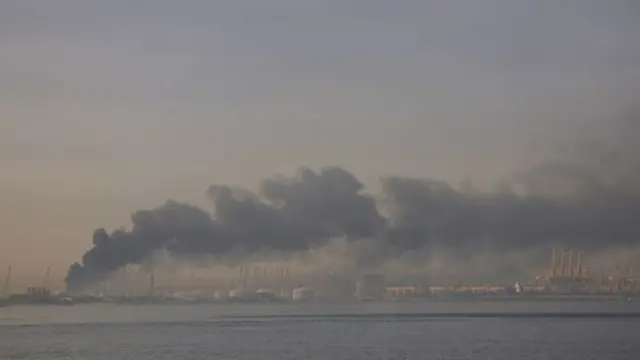
  8. Smoke and fire after Iranian strikes in the Gulfpublished at 09:00 GMT 1 March

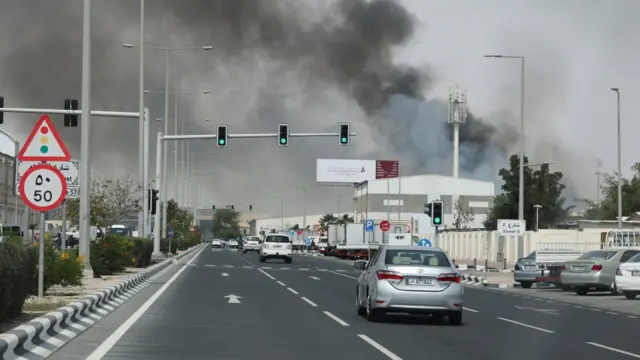
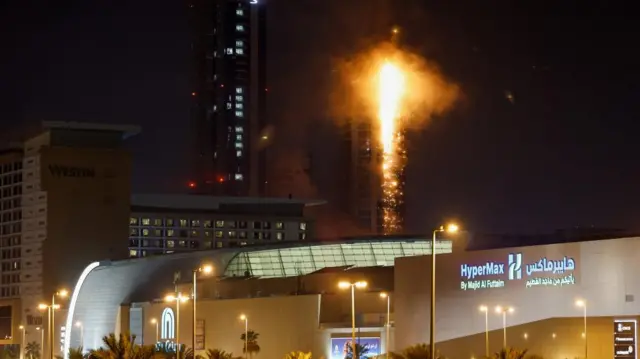
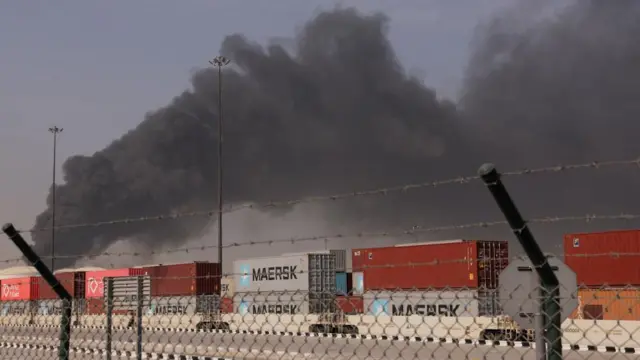
    We're seeing photos now of black smoke and fire billowing from buildings following Iranian retaliatory strikes on US allies in the Gulf.

    The photos, captured overnight and this morning local time, show fires in Bahrain's capital Manama and the Jebel Ali port in Dubai, UAE.

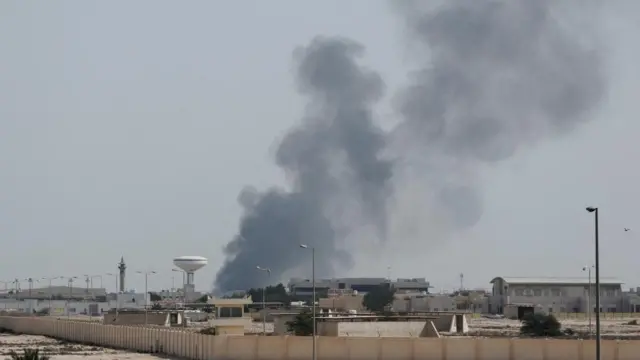
    A cloud of grey and black smoke rises can be seen from the side of a highway with two lanes. A silver car is driving near some traffic lights in the front of the pictureImage source, Reuters
    Image caption,

    Smoke was seen from Doha after an Iranian missile attack

    A streak of flames runs up the side of a tower block at night. Several buildings can be seen in front of the burning towerImage source, Reuters
    Image caption,

    Smoke rises from a burning building hit by an Iranian drone strike in Manama, the capital of Bahrain

    Thick black smoke billows in the backdrop.Red and grey containers are stacked in front of it and there is barbed wire in the front of the photoImage source, Reuters
    Image caption,

    Black smoke was seen billowing from Jebel Ali port in the United Arab Emirates after an Iranian attack

  9. Iranian jets bomb US bases in Middle East - state mediapublished at 08:51 GMT 1 March

    Iran says its air force pilots successfully bombed US bases in Gulf countries and the Kurdistan region of Iraq, according to the state news agency IRNA.

    The Iranian army says pilots successfully struck the bases in several phases, adding that all "enemy military centres" in the region are within reach of the Air Force's fighter jets.

  10. Tel Aviv neighbourhood shows reach of Iran's missilespublished at 08:45 GMT 1 March

    Jon Donnison
    Reporting from Tel Aviv

    People stood in front of a damaged building in Tel Aviv, Israel.Image source, EPA/Shutterstock
    Image caption,

    In Tel Aviv, Israel, Iranian missiles have left buildings damaged

    In a residential neighbourhood in central Tel Aviv you can see the impact of where one Iranian ballistic missile hit.

    It left one woman dead, the first reported fatality in Israel of this war.

    The apartment block where she was living is blown out. Bulldozers are on the scene to clear up the rubble.

    On the drive here, we saw explosions directly overhead as more Israeli interceptors took out Iranian missiles.

    Israel’s air defence system has shot down almost all of Iran’s missiles. But some can still get through especially when fired in a concentrated barrage.

  11. Israel says it is striking Iranian regime targets in Tehranpublished at 08:39 GMT 1 March

    The Israel Defense Forces says it has started a wave of strikes against targets linked to the Iranian regime in Tehran.

    "Over the past day, the Israeli Air Force conducted large-scale strikes in order to establish aerial superiority and to pave the path to Tehran," a statement says. It adds it is striking targets "in the heart of Tehran".

    Iranian media reports explosions have been heard in the capital.

  12. Explosions in Doha as Iran carries out retaliatory strikes in the Gulfpublished at 08:31 GMT 1 March

    Barbara Plett Usher
    Reporting from Doha

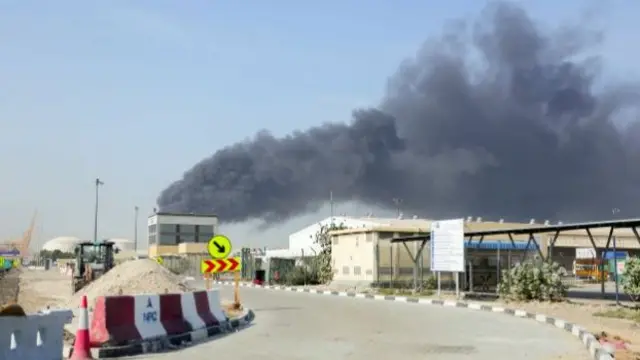
    Smoke rises after reported Iranian missile attacks, following United States and Israel strikes on Iran, as seen from Doha, Qatar.Image source, Reuters

    Iran has resumed its air strikes on Arab Gulf countries, continuing to target US bases across the region. We heard a heavy round of explosions this morning in Doha and a plume of smoke is visible from the city.

    The interior ministry said it was responding to a limited fire in an industrial zone caused by debris from an intercepted missile.

    In a press conference around midnight, Qatari officials said Iran had launched 65 missiles and 12 drones yesterday – most of them were intercepted, but there has been some damage and eight people were injured by the fallout.

    Explosions have also been heard in Dubai and Manama this morning, and the Oman state news agency is reporting a drone attack on its commercial port. Oman has been a key mediator in the US-Iran talks for years and had so far been spared Iranian attacks.

    Qatar and some other Arab governments have strongly condemned the strikes and reserved the right to respond.

    The Gulf states had made efforts to ease tensions with Iran in recent years, they worked hard to mediate a diplomatic solution to the crisis and have refused to let the US launch attacks from its bases in their countries.

    But that wasn’t enough to prevent direct military strikes on their territory. And now with the violent death of Iran’s supreme leader, the future looks uncertain not only for Iran, but for the region.

  13. What to know as Iran retaliates for death of Khameneipublished at 08:23 GMT 1 March

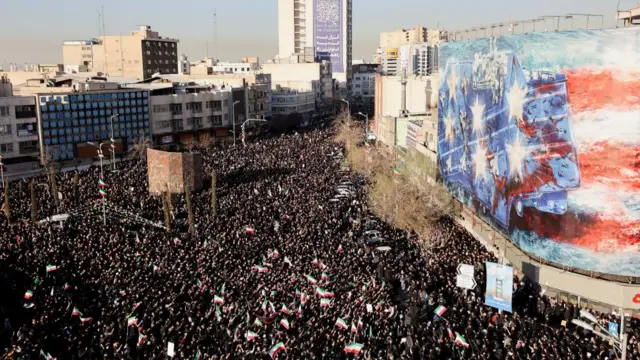
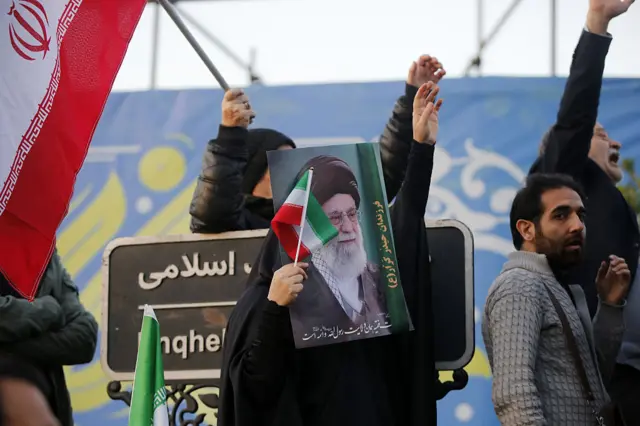
    People gather in Tehran to mourn the death of Ayatollah Ali KhameneiImage source, Reuters
    Image caption,

    People gather in Tehran to mourn the death of Ayatollah Ali Khamenei

    Iran has warned of "devastating" retaliation after strikes by the US and Israel that killed Supreme Leader Ayatollah Ali Khamenei.

    Some Iranians have been celebrating the news of Ali Khamenei's death, while others have been seen mourning in the streets.

    Saturday saw Tehran retaliate with strikes reported across the Middle East, and the Islamic Revolutionary Guard Corps (IRGC) warned that they will attack Israel and US military bases in a "devastating offensive operation".

    In response, Trump has warned Tehran not to strike back, saying: "IF THEY DO WE WILL HIT THEM WITH A FORCE THAT HAS NEVER BEEN SEEN BEFORE".

    Elsewhere, US Secretary of State Marco Rubio is due to hold a call with G7 leaders after UK PM Keir Starmer said on Saturday that British planes were "in the sky" as part of coordinated defensive efforts.

    Four people were also injured in an incident at Dubai International Airport, with new pictures showing damage in the city.

    Chief international correspondent Lyse Doucet writes of Iran's leadership: In this moment of turmoil, authorities will want to project stability and a seamless transition.

  14. Analysis

    Israel believes it has reshaped the Middle Eastpublished at 08:14 GMT 1 March

    Paul Adams
    Diplomatic correspondent

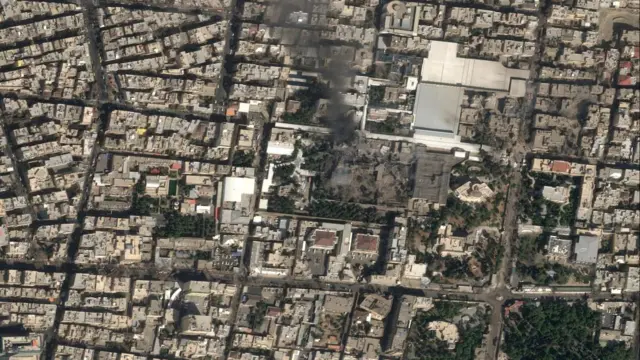
    A satellite image shows black smoke rising from a compound surrounded by a grid of housingImage source, Reuters
    Image caption,

    A satellite image shows heavy damage and black smoke rising at Iranian Supreme Leader Ayatollah Ali Khamenei's compound

    Israel’s ability to reach out and kill its mortal enemies has been proved, repeatedly, over the past two years.

    With and without US assistance, using everything from exploding pagers to precision missiles and bunker busting bombs, Israel has eliminated key opponents in Gaza, Lebanon, Yemen and Iran.

    The leaderships of Hamas, Hezbollah, the Houthis and now the Islamic Republic of Iran have been devastated.

    The impact on what Iran calls the “Axis of Resistance” and Israel dubs the “Axis of Evil”, cannot be underestimated.

    Another key figure, the former Syrian dictator Bashar al-Asad, is in exile in Moscow.

    For Israel, killing Ayatollah Khamenei marks the climax of this campaign: the removal of the lynchpin of the axis and everything that it represents.

    Israel believes it has reshaped the Middle East. It has certainly rarely looked more powerful than it does right now.

    But these are uncertain times. It would be rash to predict with any confidence what will emerge from the ashes of the axis.

    From Iran, we see glimpses of both euphoria and grief in the videos emerging on social media. This huge, proud nation seems destined for a period of dangerous instability.

    Killing your enemies is one thing. Making sense of the aftermath is another.

  15. Islamic Revolution 'becomes more rooted through martyrdom' - Iranian vice presidentpublished at 08:02 GMT 1 March

    Iranian state media outlet IRNA has shared a message from the first vice-president of Iran, Mohammad Reza Aref.

    "Today, Islamic Iran is in mourning; but this mourning is not a mourning of passivity," he says. He says the US and Israel thought they could they could "shake the soul of a nation" by killing the country's supreme leader.

    But the Islamic Revolution "becomes more alive and rooted through martyrdom", Aref says.

    He says the strategy is protecting national stability and internal cohesion.

  16. The senior Iranian figures killed in attack by US and Israelpublished at 07:49 GMT 1 March

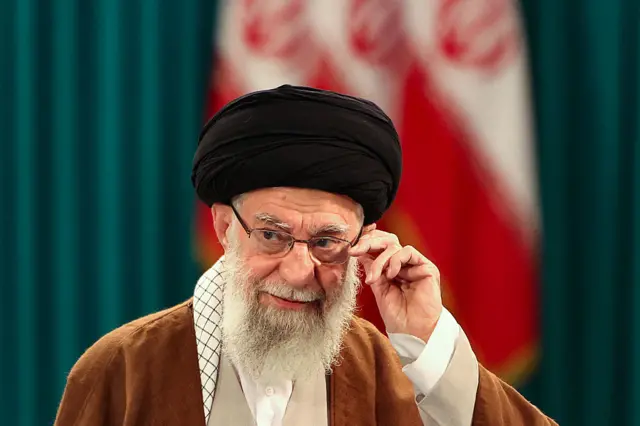
    KhameneiImage source, Getty Images

    A number of senior figures in Iran are known to have been killed in Saturday's strikes on Iran.

    They include:

    • Ayatollah Ali Khamenei, Iran's supreme leader, who was killed on Saturday morning at his office
    • Iranian television reports that the country's armed forces chief of staff Abdolrahim Mousavi was killed in air strikes
    • Tehran has also confirmed the death of the commander of the Revolutionary Guards, General Mohammad Pakpour
    • State media has also reported that Khamenei's daughter, son-in-law and grandchild were killed in the attack
    • An intelligence source and military source has told CBS News that overall around 40 Iranian officials were killed in the strikes
  17. What to know about strikes around the Middle Eastpublished at 07:24 GMT 1 March

    Explosions and sirens have rung out across the Middle East today, as Iran retaliates for the Israeli-US attack and the death of its supreme leader, Ayatollah Ali Khamenei.

    Here's what to know:

    US-Israeli strikes on Iran

    These strikes hit 24 of Iran's 31 provinces, according to Iranian Red Crescent spokesperson Mojtaba Khaledi. BBC Verify has analysed satellite footage showing significant damage to the Leadership House compound in Tehran, where the Iranian supreme leader's office was located.

    Iranian state media confirmed in the early hours of Sunday that Ayatollah Ali Khamenei was killed at his office.

    Across the country, 201 people have been killed, the Red Crescent says, including at least 108 in an explosion at a girls' school in southern Iran.

    Iran's retaliatory strikes

    Israel has been targeted by waves of missile and drone attacks, and an apartment building in Tel Aviv was destroyed. At least one woman has been killed in strikes on Israel, and 120 people are injured, emergency services say.

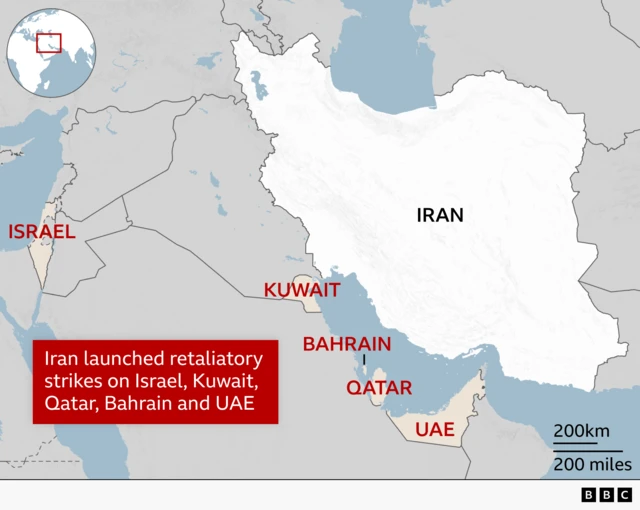
    Iran's Revolutionary Guards have targeted the US Fifth Fleet in Bahrain, alongside other US bases in the Gulf region.

    Strikes have also been reported in Dubai, Doha and Kuwait - In Dubai, four people have been injured following an incident at Dubai International Airport, one of the world's busiest aviation hubs. Additional strikes on Bahrain International Airport have also been reported to the BBC by an eyewitness.

    A graphic highlights Israel, Kuwait, Bahrain, Qatar and the UAE as sites where Iran has launched retaliatory strikes
  18. Analysis

    In this moment of turmoil, authorities want to project stabilitypublished at 07:07 GMT 1 March

    Lyse Doucet
    Chief international correspondent

    People gather to stage a demonstration after the announcement that Iranian leader Ayatollah Ali Khamenei had been killed in U.S.-Israeli attacks in Tehran, Iran on March 01, 2026.Image source, Getty Images

    Official confirmation of the ruling Ayatollah’s death came after many hours of official denial.

    A state TV presenter tearfully announced the passing of a leader he described as the "steadfast mountain of the Islamic guardianship who had drank the sweet pure draught of martyrdom".

    In this moment of turmoil, the authorities will want to project stability and a seamless transition.

    Under the constitution, the president, the head of the judiciary and a senior cleric from the powerful Guardian council will take charge in the interim while the body known as the Assembly of Experts selects his successor.

    Preparations for this defining moment had been stepped up months ago, especially as tensions intensified with the United States and Israel who made it clear that the hard-line cleric was in their sights.

  19. Photos show damage from attacks on Dubai and Israelpublished at 06:58 GMT 1 March

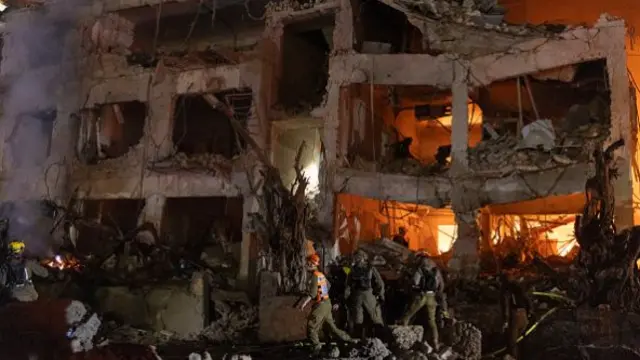
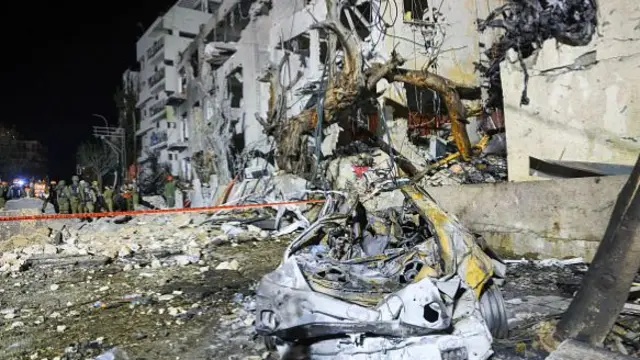
    Photos are coming through of damage caused by Iranian strikes on Dubai and Israel overnight and this morning.

    Iran attacked targets in Dubai overnight, including the emirate's international airport. Separately, Iranian missiles hit residential buildings in central Tel Aviv late on Saturday night.

    Smoke billows from Jebel Ali port in Dubai on 1 March after an Iranian attackImage source, Reuters
    Image caption,

    Smoke rises over the Jebel Ali port in Dubai on Sunday morning after an Iranian attack

    A plume of smoke rises from the port of Jebel Ali following a reported Iranian strike in Dubai on March 1, 2026.Image source, Getty Images
    Image caption,

    Smoke billows across the Dubai coastline after Iran's strikes

    A building in central Tel Aviv which was damaged by an Iranian missile which struck the city on Saturday nightImage source, Getty Images
    Image caption,

    A residential building in Tel Aviv was destroyed by an Iranian missile which struck the city on Saturday night

    Tel Aviv block of flats destroyed by missileImage source, Getty Images
    Image caption,

    Emergency teams respond to a block of flats in Tel Aviv struck by an Iranian missile

  20. BBC Verify

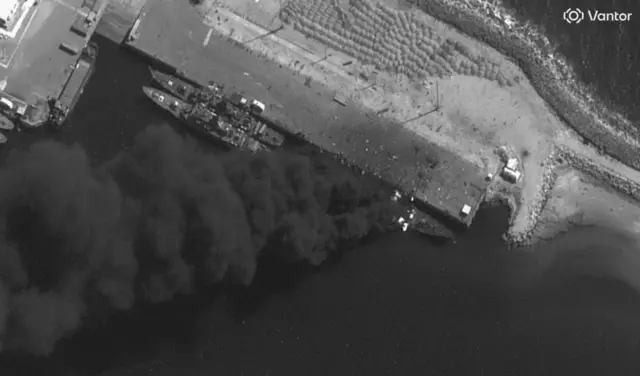
    Satellite images show aftermath of strike on Iran’s Konarak naval basepublished at 06:34 GMT 1 March

    Overhead view of Iranian naval base with smoke coming out of itImage source, Vantor

    By Shayan Sardarizadeh

    High-resolution satellite images analysed by BBC Verify show what appears to be the aftermath of a strike on an Iranian naval base on the coast of the Gulf of Oman.

    The images, captured by Vantor, show a thick column of black smoke rising from a vessel docked at the Iranian navy's Konarak base, which is located in the south-eastern province of Sistan-Baluchestan.

    Konarak is one of the four major naval bases of Iran’s army. A military air base is also located nearby.

    A wider shot of the naval base, also released by Vantor, indicates that the vessel was the only target at the time the image was captured.