Summary

  1. Khamenei’s path will continue, Iranian foreign minister sayspublished at 12:59 GMT 1 March

    Ghoncheh Habibiazad
    Senior reporter, BBC Persian
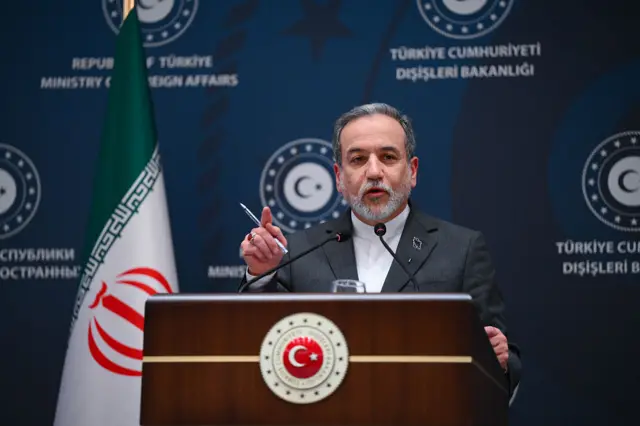
    Abbas Araghchi, in a suit, speaking behind a pdoium.Image source, Getty Images

    The Iranian foreign ministry, in its statement over the death of Iran’s Supreme Leader Ali Khamenei, has once again condemned US and Israeli strikes during the diplomatic talks between Tehran and Washington over Iran’s nuclear programme.

    The recent strikes occurred while Oman was mediating talks between Washington and Tehran, with the latest round of negotiations held in Geneva on 26 February.

    Iran’s Foreign Minister Abbas Araghchi also said in a statement that Khamenei’s path "will continue".

  2. Analysis

    Trump's team sees Iran as a win - but that could get complicatedpublished at 12:34 GMT 1 March

    Bernd Debusmann Jr
    Reporting from Palm Beach

    The sun is still rising over an overcast and drizzly Palm Beach. US President Donald Trump is still at his Mar-a-Lago estate, just a few miles from where the press is gathered.

    As things stand, the travelling White House press pool has no expectation of seeing him for much of the day. He has no public events on his schedule, meaning that our first glimpse of him - since Friday - will be when he boards Air Force One for Washington this afternoon.

    He will be back at the White House this evening.

    Trump was still on Truth Social late into the night. At approximately 01:00 local time, he posted a strongly worded message warning that Iran "better not" attempt to "hit very hard".

    "If they do, we will hit them with a force that has never been seen before," he added.

    This forceful language, in part, reflects some important domestic considerations for Trump.

    So far, he and the administration clearly see the operation in Iran as an unmitigated success. But US casualties - or the prospect of a messy, drawn-out conflict - are likely to complicate this perception.

    Some within Trump's MAGA base have already expressed misgivings about the possibility, particularly given that he campaigned with the promise of avoiding that exact scenario.

    It is unclear when we will hear from him directly, but when we do, it's likely that he will try to tamp down any suggestion that the US may find itself in a lengthy nation-building exercise with murky timelines.

  3. Starmer 'confirmed clearly' that Cyprus not a target, its president sayspublished at 12:29 GMT 1 March

    Cyprus President Nikos Christodoulides says UK Prime Minister Keir Starmer has called to confirm "clearly and unequivocally that Cyprus was not a target".

    This follows reports from UK defence sources that two Iranian missiles were fired towards Cyprus, where UK military bases are located.

    A Cyprus government spokesperson later denied this, saying there is "no indication that there was a threat to the country".

  4. A look at the senior Iranian officials killed in US-Israeli attackspublished at 12:21 GMT 1 March

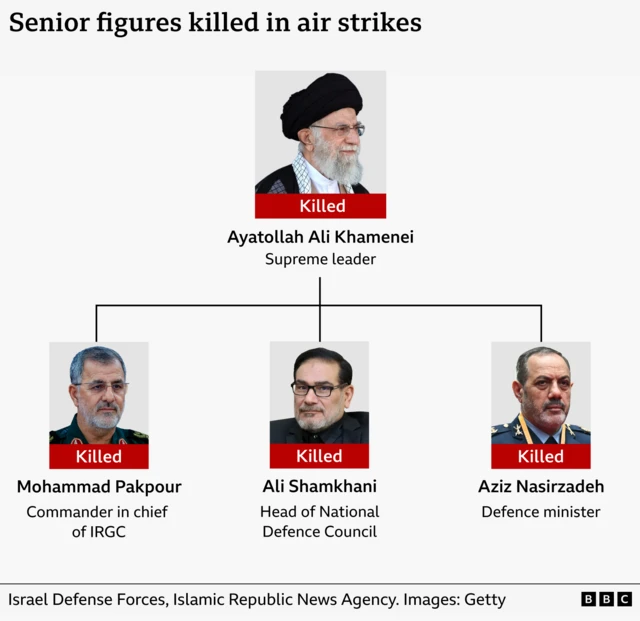
    A number of senior figures in the Iranian regime are known to have died in Saturday's strikes.

    They include:

    • Ayatollah Ali Khamenei, Iran's supreme leader, who was killed on Saturday morning at his office
    • The commander of the Revolutionary Guards, General Mohammad Pakpour
    • Security adviser Ali Shamkhani
    • Defence minister Aziz Nasirzadeh

    An intelligence source and military source have told the BBC's US partner CBS News that overall, around 40 Iranian officials were killed in the strikes.

    A graphic highlighting the senior Iranian figures who have been killed in air strikes
  5. UK advises against travel to parts of Pakistan after US consulate stormed by protesterspublished at 12:15 GMT 1 March

    Azadeh Moshiri
    South Asia correspondent

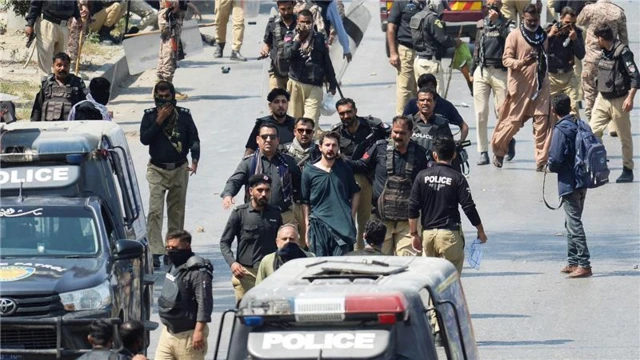
    Security forces detain a protester outside the U.S. Consulate General, following news of U.S. and Israeli strikes on Iran that killed Iran's Supreme Leader Ayatollah Ali Khamenei, in Karachi, Pakistan March 1, 2026.Image source, Reuters
    Image caption,

    Security forces detain a protester outside the US Consulate General, in Karachi

    The UK’s Foreign Office has updated its advice to British nationals in Pakistan and restricted movements for its British staff in the wake of violence at the US consulate in Karachi.

    Earlier, hundreds of protesters stormed the US consulate in southern Pakistan in reaction to the strikes in Iran, killing nine people and injuring at least 32 others during clashes between police and protesters, according to a local hospital.

    Pro-Iran demonstrations are still unfolding across Pakistan, where there are Shia communities who have been longtime supporters of Iran’s regime. Hundreds of protesters have been trying to reach the US consulate in Lahore, but are being held off by police.

    In Pakistan-administered Gilgit Baltistan, protesters gathered and burned a UN building. It’s a region where posters of Iran’s supreme leader have been displayed in public for years.

    The US-Israeli strikes are forcing Pakistan’s government to navigate a fine line between its growing relationship with Donald Trump and its support for Iran. The foreign minister has already condemned what he called “unwarranted attacks against Iran” after a call with his counterpart there.

    Shia organisations are calling for more rallies across Pakistan. Police say they’re already taking measures to protect the US embassy in the capital Islamabad, where protesters are now heading.

  6. Analysis

    For the Gulf states, a red line has been crossedpublished at 12:07 GMT 1 March

    Frank Gardner
    Security correspondent

    Iran’s explosive drones and missiles have been expanding their target set well beyond military sites such as the (largely evacuated) US Fifth Fleet naval base in Bahrain.

    Now luxury hotels and shopping malls, high-rise apartment blocks, state-of-the-art airport departure terminals are sporadically getting hit as gaps appear in the Arab Gulf states’ air defences.

    These places were never built with the prospect in mind that they would one day come under attack from drones and ballistic missiles.

    For rulers of the Gulf states, dynastic monarchies for whom the revolutionary zeal of the Islamic Republic is anathema, a red line has been crossed here.

    It is hard to see how they can ever have anything approaching normal relations again with the current Iranian leadership, if it survives this war.

    Iran has attacked the Gulf states before, both directly and indirectly. In 2019, an Iranian-backed militia in Iraq launched a volley of drones at Saudi Aramco’s petrochemical facilities, temporarily knocking out half its exports.

    Last year Iran fired ballistic missiles at the Al-Udaid airbase in Qatar, but gave advance warning. And Bahrain has long accused Iran of funding, training and arming insurgents in its country.

    All of this, though, pales compared to the situation the Gulf Arab states are now experiencing.

  7. Strikes across the Gulf and repercussions around the world: Here's what to knowpublished at 12:00 GMT 1 March

    Gabriela Pomeroy
    Live reporter

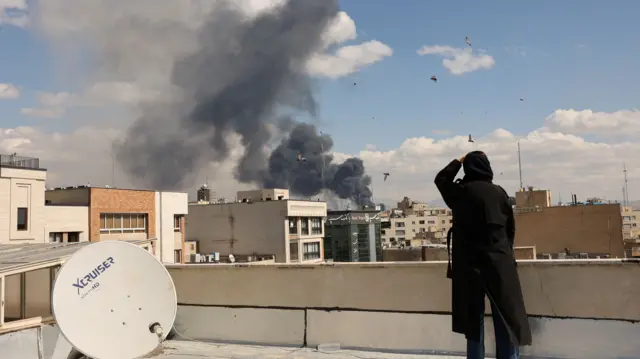
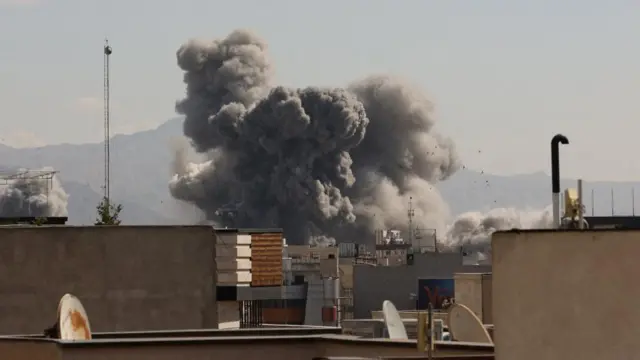
    Smoke rises in Tehran on 1 MarchImage source, Reuters

    Israel's joint strikes with the US on Iran have disrupted the Middle East, with ripple effects beyond the region.

    This story is rapidly developing, but here's what to know this hour:

    In Iran: The Israel Defense Force (IDF) launched a fresh wave of strikes on targets in Tehran on Sunday morning. Pictures showed dark smoke billowing over the city, and BBC Persian reported explosions were heard in the capital. Israeli media reported that 30 senior Iranian officials were killed in the previous day's strikes, and Iran's president said revenge was "legitimate".

    In Israel: Officials in Tel Aviv said 40 buildings were damaged by Iranian ballistic missile strikes, with two people killed. Israel's ambulance service said it had taken 20 people to hospital. Sirens sounded across the country, but air defences shot down most of the missiles.

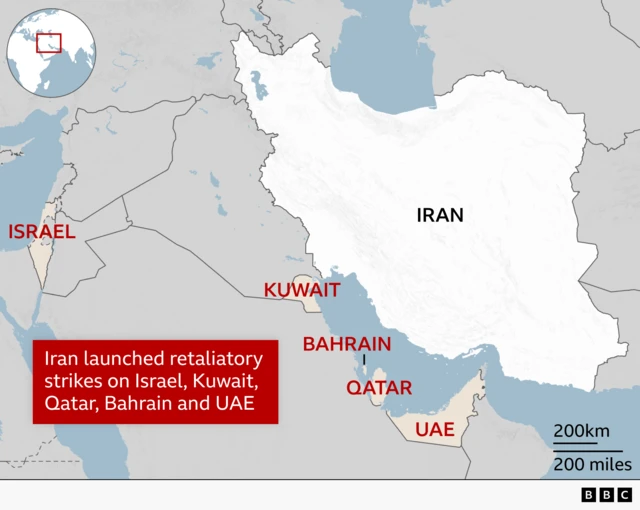
    In the Gulf and Cyprus: Iran resumed air strikes on Dubai,, external Qatar, Bahrain, Kuwait and Oman, saying it was targeting US bases on the region. A British man living in Dubai told the BBC it was a "traumatic 24 hours. We have been hearing bombs going off and the house has been vibrating."

    Airspace is closed around the region in response to the ongoing strikes.

    The UK Defence Secretary John Healey said two Iranian missiles were fired towards Cyprus, where the UK has military bases, but it's thought they were not targeting British installations. Cypriot officials, however, have disputed that missiles are heading in its direction.

    In Pakistan: The events in Iran are having repercussions elsewhere. In the Pakistani city of Karachi there were violent clashes outside the US consulate. Hundreds of people joined a protest in solidarity with Iran, and nine people were killed after clashes with police, a doctor tells the BBC.

  8. Official denies missiles launched towards Cypruspublished at 11:48 GMT 1 March

    A spokesperson for Cyprus's government has denied that any missiles were launched towards the country, after the UK's defence secretary said "two ballistic missiles [were] fired in the direction of Cyprus".

    John Healey told the BBC "we are pretty sure they weren't targeted at Cyprus", where there are UK military bases.

    "In relation to statements and publications referring to the launch of missiles in the direction of Cyprus, it is clarified that this is not the case and there is no indication that there was a threat to the country," Konstantinos Letymbiotis says.

    "The competent authorities are closely monitoring the situation."

  9. UK Foreign Office warns British citizens against all but essential travel to several Gulf statespublished at 11:42 GMT 1 March

    The UK Foreign Office is advising against "all but essential travel to Bahrain, Kuwait, Qatar and the UAE".

    "If you are a British national in those countries, you should shelter in place and register your presence," it adds in a post on X.

    It comes as airlines are continuing to cancel and divert flights serving the Middle East after the US-Israeli strikes against Iran, and Tehran's retaliatory attacks.

  10. Oil tanker hit off the coast of Omanpublished at 11:33 GMT 1 March

    An oil tanker has been struck off the coast of Oman, injuring four people, according to Oman's Maritime Security Center.

    It says an oil tanker named Skylight and flagged to the Republic of Palau, was attacked around five miles (8km) from the port of Khasab in the north of the country.

    Four of the crew members were injured and all 20, including 15 Indian citizens and five Iranian citizens, were evacuated. The Maritime Security Center did not detail what hit the vessel.

    Earlier the Oman News Agency reported that the commercial port of Duqm was targeted by two drones. One person was injured when a drone struck a mobile workers' housing unit, while the debris of the second drone landed near fuel storage tanks, a security source told the agency.

  11. Hezbollah leader mourns 'martyr' Khameneipublished at 11:23 GMT 1 March

    Carine Torbey
    BBC Arabic correspondent, in Beirut

    Hezbollah leader Naim Qasem speaking against a blue backgroundImage source, Reuters
    Image caption,

    Hezbollah leader Naim Qasem, shown speaking in September, has called Ali Khamenei a martyr

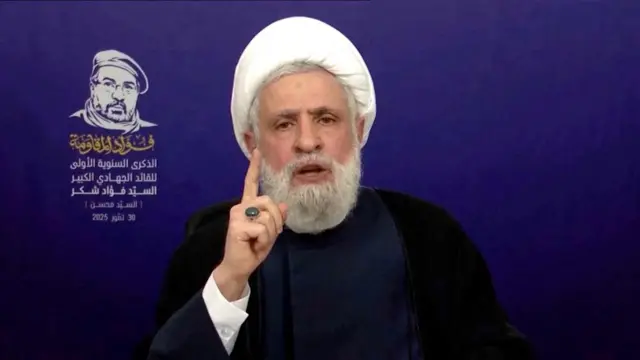
    Hezbollah leader Naim Qasem has mourned the Iranian Supreme Leader Ali Khamenei, calling him a martyr who leaves behind tens of millions of devotees.

    Qasem said that what he described as “the criminal American and Zionist aggression” that targeted Khamenei represented "the height of criminality”, pledging “we will fulfil our duty in confronting aggression, confident in Allah’s victory, guidance, and support".

    Hezbollah, the armed Shia group in Lebanon which is considered one of the most prominent groups sponsored by Iran in the region, is organising a public gathering later today in loyalty to Khamenei and in support of Iran.

  12. Flights cancelled as airspace closes across Middle Eastpublished at 11:13 GMT 1 March

    Airlines are still cancelling and diverting flights in and around the Middle East following the US-Israel attack on Iran and Tehran's retaliatory strikes.

    All flights from Dubai International and Dubai Al Maktoum are suspended until further notice.

    The Emirates airline says it has suspended all operations from Dubai until at least 15:00 local time on Monday, blaming airspace closures, while Etihad has suspended flights out of Abu Dhabi until 02:00 on Monday for the same reason.

    Four staff at Dubai International were injured in an incident overnight.

    British Airways has cancelled flights to Tel Aviv and Bahrain until Wednesday and is also warning of impacts on services to Abu Dhabi, Amman, Doha and Dubai.

    Virgin Atlantic has also cancelled flights between London and Dubai and London and Riyadh on Sunday and Monday.

    Singapore Airlines and Air India are among the other airlines that have altered their schedules in the wake of events in the Middle East.

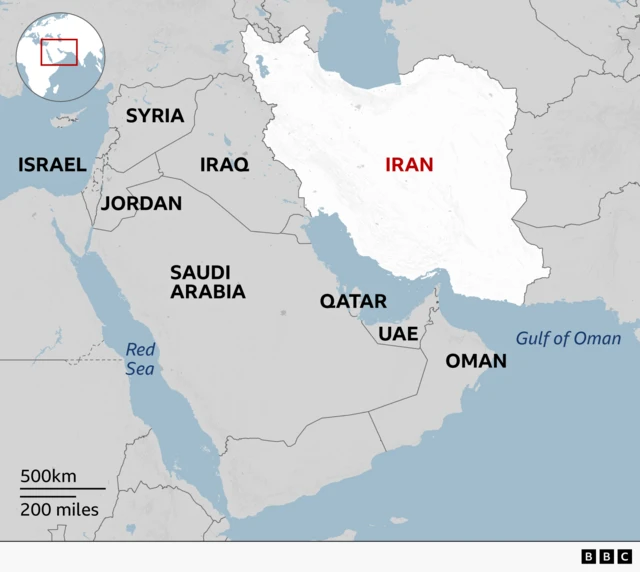
    A regional map highlighting Iran in white with its name in red. Surrounding countries are labeled in grey, neighbouring Iraq to the west and other Middle Eastern countries including Syria, Jordan, Israel, Gaza and Saudi Arabia, Qatar, UAE, and Oman. Bodies of water such as the Red Sea and the Gulf of Oman are marked in blue.
  13. Analysis

    Iran's system designed to function after supreme leader's deathpublished at 11:05 GMT 1 March

    Raffi Berg
    Middle East digital editor

    The killing of Supreme Leader Ayatollah Ali Khamenei is a huge blow to Iran, but it does not automatically produce regime change, nor is it likely to shorten the conflict.

    Although Khamenei was a towering figure – Iran’s un-challengeable ruler for the past 37 years – the system of rule is designed to continue functioning after his death.

    Since the 1979 revolution, Iran has been governed by Shia religious leaders, and its political and military institutions are structured to protect this form of rule.

    A system is in place to appoint a successor to Khamenei, an election by a body of 88 religious figures known as the Assembly of Experts. These clerics are loyal to the regime and will choose someone who will continue Khamenei’s path.

    But Iran’s most powerful institution is the Islamic Revolutionary Guards Corp (IRGC), a pervasive, ideological military force whose purpose is to guard Iran’s Islamic system. It is fighting back against the US and Israel and will tolerate no dissent at home.

    The IRGC is expected to play a decisive role in shaping the succession – and in ensuring that any new leader protects its interests.

  14. Iran state media says 57 people killed in Tehran attackspublished at 10:52 GMT 1 March

    An explosion with large plumes of smoke over buildings in Tehran.Image source, Reuters
    Image caption,

    Smoke rises following a strike on Tehran, Iran

    Quoting the Tehran Province Red Crescent Society, Iran's state-run Islamic Republic News Agency (IRNA) says Tehran has been hit by 60 attacks in 24 hours, leaving 57 people dead.

    Israel's military says it has been targeting the capital, with smoke seen billowing above the city.

  15. Putin offers condolences to Iran over 'cynical murder' of Khameneipublished at 10:46 GMT 1 March

    Russian President Vladimir Putin has expressed his condolences over the death of Iranian Supreme Leader Ali Khamenei, the Russian state news agency TASS reports.

    He described Khamenei's death as a "cynical murder that violated all norms of human morality and international law".

    Russia is an ally of Iran. Last year, the two countries agreed to closer military co-operation and signed a 20-year "strategic partnership" treaty.

  16. Gulf nations intercept latest wave of strikes from Iran, but some injuries reportedpublished at 10:40 GMT 1 March

    Bahrain: Bahrain's air defence systems have successfully intercepted and destroyed a fresh wave of Iranian ballistic missiles and drones, state media has reported. Officials told the Bahrain News Agency that "limited debris" landed in several areas.

    Kuwait: State media in Kuwait also report that the country's air defences repelled "a number of hostile aerial targets" on Sunday morning. The defence ministry says targets were intercepted in the south and no casualties were reported, according to Kuwaiti media.

    Qatar: The country's defence ministry says its fighter jets and air defence systems successfully countered drones and missiles launched by Iran towards it's air space, the state-run Qatar News Agency reports.

    UAE: A woman and child sustained minor injuries after debris from an intercepted drone fell on to the facade of one of the buildings at Etihad Towers, according to the Abu Dhabi Media Office.

    A graphic shows a map of the Middle East and highlights Israel, Kuwait, Bahrain, Qatar and the UAE. It explains Iran, which is highlighted in white, has launched retaliatory strikes against the nations
  17. Who is Iran's key military leader right now?published at 10:32 GMT 1 March

    Ghoncheh Habibiazad
    Senior reporter, BBC Persian

    With the deaths of several senior Iranian commanders during strikes by the US and Israel, the question is who the key military figure in Iran is now.

    From reports in Iranian media, it seems to be Maj Gen Ali Abdollahi. He is currently the commander of the Khatam al-Anbiya Central Headquarters, which co-ordinates national defence between the army and the IRGC, the Islamic Revolutionary Guard Corps, which named a new commander earlier.

    According to Iranian media reports, Abdollahi was among the group mourning the death of Khamenei in Tehran today.

    He says that Iran will “respond to the threats of enemies on the battlefield” and also said “the readiness of the armed forces is greater than ever”.

    Abdollahi was sanctioned by the US in January 2020 along with other military commanders in response to Iranian missile attacks on US military bases in Iraq.

  18. Analysis

    An existential battle for Iran's leadershippublished at 10:26 GMT 1 March

    Hugo Bachega
    Middle East correspondent in Jerusalem

    It is day two of the joint US-Israel attacks on Iran after the initial phase that included the killing of Supreme Leader Ayatollah Ali Khamenei at his residence in Tehran, heralding a defining moment in the Islamic Republic’s 47-year history.

    The operation exposed the vast intelligence that the Americans and Israelis have about the Iranian apparatus, and the inability of the country’s military to protect its most important figures. But what happens next?

    For the Iranian leadership, this is an existential battle, and they had planned for this moment, particularly after last year’s 12-day war with Israel.

    Both US President Donald Trump and Israeli Prime Minister Benjamin Netanyahu are openly encouraging Iranians to seize what Trump has described as “probably [the] only chance for generations” to take over their government. The hope is regime change, as they see it.

    It is still early to say if the bombing will lead to a resurgence of the anti-government movement, after protests were brutally repressed and thousands of people were killed earlier this year.

    The demonstrations exposed huge public discontent amid mounting questions about the legitimacy of cleric rule and an economy in deep crisis. But crucially, the powerful Islamic Revolutionary Guards Corps remained on the leaders’ side.

    Iran’s armed forces are vowing to react with force, but it is still unclear how far they can go. Its military capabilities, which were significantly damaged in last year’s war, are under attack, while its proxies in the region, also degraded, have so far remained quiet, probably to avoid becoming a target.

    Trump has warned Iran that it could face “a force that has never been seen before” if they retaliate hard. He has indicated that the bombing is likely to continue, but we still do not know for how long or what exactly he hopes to achieve before he can claim that his mission had been accomplished.

  19. Two Israelis killed in missile attack - IDFpublished at 10:20 GMT 1 March

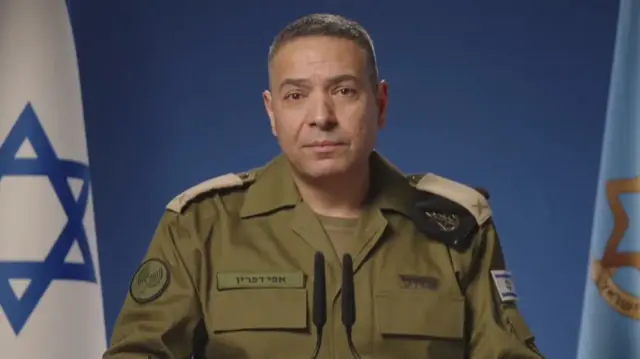
    Effie DefrinImage source, IDF

    IDF spokesperson Effie Defrin says two Israelis have been killed in Iran's retaliatory attack.

    In a briefing, Defrin says: “Even though we have extensive operations of the IDF air defence systems, it's still not foolproof.” He urges people in Israel to follow instructions from the authorities and take shelter when under attack.

    Defrin says the IDF has “severely damaged” Iran’s defence system, adding that Israel is working with the US military to continue its attack.

    “We're going to continue with that campaign until we manage to achieve all the goals we have set for ourselves,” he says.

    In addition to the two deaths reported, Israel's Ministry of Health says that since the start of the attack on Iran, 456 people have been taken to hospital. Of those, 86 are still in hospital and in intensive care, it says.

  20. Iranian president says revenge 'legitimate'published at 10:15 GMT 1 March

    The president of Iran, Masoud Pezeshkian, says Khamenei's killing marks an “open war against Muslims, especially Shiites, in all corners of the world”.

    In a statement published on the official Telegram channel of the Iranian government, Pezeshkian says Iran “considers bloodshed and revenge against the perpetrators and instigators of this historical crime as its legitimate duty and right, and will do its utmost to fulfil this great responsibility and duty".

    Questions had been circulating about Pezeshkian's whereabouts - a spokesperson for his office says that the Iranian president is in "perfect health and safety".