Summary

Media caption,

Triple killer questioned by police outside MI5

  1. Valdo Calocane's former flatmate now giving evidencepublished at 14:56 GMT 3 March

    A former flatmate of Valdo Calocane, known only as Sebastian, is now giving evidence to the inquiry.

    We heard earlier in the inquiry that Sebastian lived with Calocane for a period between 2019 and 2020, and then again in 2021.
  2. Who is Valdo Calocane?published at 14:48 GMT 3 March

    We now know Valdo Calocane as the man responsible for killing three people in Nottingham on 13 June 2023.

    But, what else do we know about perpetrator of the Nottingham attacks?

    Calocane, who referred to himself as Adam Mendes, was born in Guinea-Bissau on 4 September 1991.

    His family moved to Portugal when he was three, before coming to the UK in 2007 when he was 16 years old.

    The triple killer completed a degree in mechanical engineering at the University of Nottingham, graduating in June 2022, when he was aged 30.

    During his sentencing, defence barrister Peter Joyce KC said Calocane's early life had been "uneventful" until his mental health issues started in 2019.

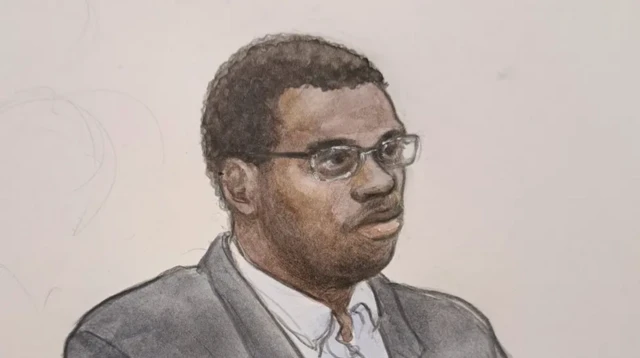
    A court sketch of Valdo CalocaneImage source, Helen Tipper
  3. Inquiry hoping to find 'key themes'published at 14:33 GMT 3 March

    As the inquiry continues, it is worth remembering what this public inquiry is hoping to achieve.

    Led by retired senior judge Her Honour Deborah Taylor (pictured), the review will examine the attacks, including hearing the concerns of survivors and bereaved families.

    Speaking on the opening day of the hearings last Monday, Rachel Langdale KC, counsel to the inquiry, suggested that "key themes" be identified, providing a "baseline critique upon which we will build".

    Judge Deborah TaylorImage source, PA Media

    Meanwhile, the victims' families have described it as "a test of whether this country is prepared to confront failure and fix it".

    "For years we have heard apologies. We have seen reviews, we have read reports, but apologies do not keep the public safe - change does," they said in a statement.

    "We are not here for sympathy, we are here for safeguards, not reflection, not regret. Reform.

    "That is the legacy Barnaby, Grace and Ian deserve, and that is what public safety now demands."

    Once all evidence has been heard, the chair will have to provide a final report and make recommendations by May 2027.

  4. 'Absence of information' about MI5 visitpublished at 14:23 GMT 3 March

    The inquiry has heard that FTAC - a specialist unit that manages threats posed to public figures and protected sites by "fixated, lone individuals" - could have looked at Valdo Calocane's medical records, but it did not.

    Supt Busby-McVey, of the FTAC, told the inquiry the department - which looked into Calocane after he visited the MI5 headquarters on 31 May 2021 asking to be arrested - had a "very narrow remit".

    Tim Moloney KC, representing the bereaved families, asked: "Could an FTAC assessor access medical records if they thought it was necessary it order to make an appropriate assessment?"

    "For that, I would say yes," Busby-McVey said.

    Sophie Cartwright KC, representing the survivors of the Nottingham attacks, is asking why Calocane was not asked why he had attended Thames House asking to be arrested.

    She said: "There's an absence of relevant information by not asking the question, would you agree?"

    "Yes," Busby-McVey replied.

  5. Listen: Round-up from week one of the Nottingham Inquirypublished at 14:11 GMT 3 March

    During the first week of the inquiry, former senior judge Deborah Taylor KC heard from a number of witnesses regarding their contact with Valdo Calocane.

    Our reporter, Asha Patel - who was in London last week and is at Mary Ward House today - spoke about the week of evidence.

  6. Hearing back under waypublished at 14:01 GMT 3 March

    The hearing is now continuing to hear evidence from Supt Lorraine Busby-McVey.

  7. What happened on the day of the Nottingham attacks?published at 13:56 GMT 3 March

    Valdo Calocane plunged Nottingham into chaos on the morning of 13 June 2023.

    Police were first called after Barnaby Webber and Grace O'Malley-Kumar were stabbed to death in Ilkeston Road at 04:04 BST, while walking home from a night out in Nottingham.

    An hour later, Calocane tried to gain access to a residential hostel in Mapperley Road, but was forced to retreat after being punched in the face.

    At 05:14 BST, Ian Coates was stabbed while in his van in Magdala Road. He was pulled from the vehicle and Calocane drove it away.

    Nine minutes later, the triple killer drove into Milton Street and hit pedestrian Wayne Birkett, who suffered serious injuries.

    Calocane then knocked down Sharon Miller and Marcin Gawronski as they crossed Market Street six minutes later.

    At 05:34 BST, Calocane was arrested after officers managed to stop the Vauxhall Vivaro van in Bentinck Road.

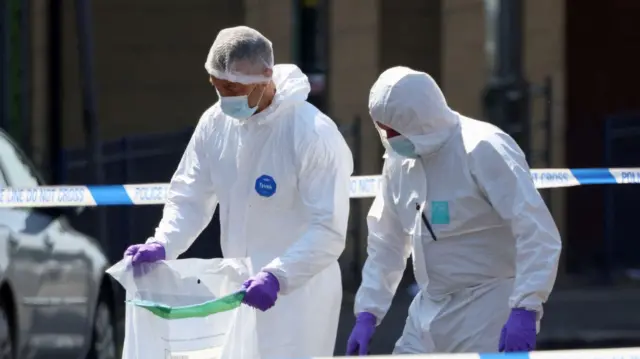
    Forensics carrying a plastic bagImage source, Reuters
  8. What have the victims' families said?published at 13:39 GMT 3 March

    Speaking ahead of the inquiry, the families of Barnaby Webber, Grace O'Malley-Kumar and Ian Coates said they hoped the inquiry would give them "the full truth".

    Grace's father, Dr Sanjoy Kumar, said: "She is the driving force behind everything that we do and everything that I do, and we will be relentless.

    "The only way we will do that is by holding people accountable, otherwise things won't change.

    "We want absolute transparency. Patients and relatives deserve transparency."

    Meanwhile, Emma Webber, the mother of Barnaby, said the beginning of the inquiry hearings came with a sense of "validation".

    She said she wanted "the truth".

    "I mean the proper truth, not just versions thereof," she added.

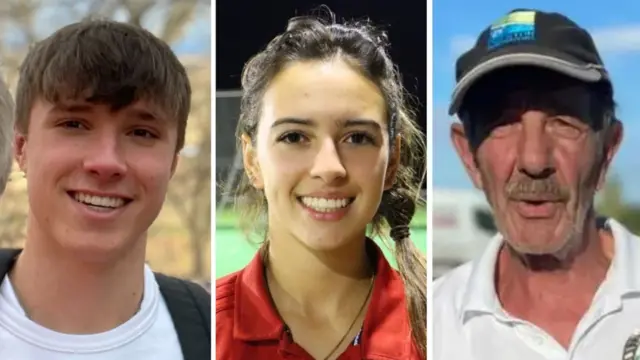
    Ian Coates, Barnaby Webber and Grace O'Malley-Kumar
  9. Valdo Calocane's former flatmate due to give evidencepublished at 13:32 GMT 3 March

    After the break, we're expecting to hear from Sebastian, a former flatmate of Valdo Calocane.

    We've already heard the inquiry make reference to incidents involving Sebastian.

    Sebastian, the inquiry was told, lived with Calocane between 2019 and 2020, and again in 2021 when Calocane moved back to accommodation near the University of Nottingham campus in Ilkeston Road.

    We heard in opening statements that on one occasion in July 2021, Calcocane "grabbed hold of Sebastian and forced him back against a wall".

    In a second incident in the same month, Sebastian heard Calocane trying to get into his room - which was locked - in the early hours.

    We have also heard that there were further phone calls from Calocane to Sebastian and in 2022, Calocane approached him at the gym.

  10. Police should have carried out own assessment, Met officer sayspublished at 13:23 GMT 3 March

    The inquiry heard a dissemination report - FTAC's assessment - was passed on to Nottinghamshire Police to make officers aware someone in its area had visited a "protected site in London".

    Supt Busby-McVey said she would have expected the force to then carry out its own assessment, and to work with local mental health services and local authorities to carry out a welfare check, or refer Calocane to other services.

    "I would have quite liked for that to have happened," she said.

    Although the report was sent to the force, it was not available to all officers.

    Supt Busby-McVey said a new system was now in place to share information better with other forces.

  11. Proceedings break for lunchpublished at 13:13 GMT 3 March

    As the inquiry breaks for lunch, we can reflect on what has been heard so far today.

    Earlier this morning, the inquiry heard from PC Foster, who responded to calls that Calocane had visited the MI5 headquarters in Westminster on 31 May 2021.

    He rang a bell to try and gain entry twice, but was refused.

    Calocane told Foster he wanted to speak to someone, but would not disclose what he wanted to talk about to officers.

    He then left the area in an Uber.

    The inquiry then heard from Supt Lorraine Busby-McVey, from the Met Police, who works within the Fixated Threat Assessment Centre (FTAC) - a specialist unit that manages threats posed to public figures and protected sites by "fixated, lone individuals".

    She said Calocane was "looked at", but did not meet the threshold for the FTAC criteria.

  12. Watch: I have been arrested once, Valdo Calocane tells officerspublished at 12:59 GMT 3 March

    Bodycam footage shown to the inquiry earlier showed Valdo Calocane was questioned on whether he had ever been arrested before.

    While standing outside of MI5's Thames House in London, he can be heard saying "not really", before going on to tell officers that he had been detained previously.

  13. Inquiry told Calocane texted brother saying he heard voicespublished at 12:51 GMT 3 March

    The inquiry has been told the Fixated Threat Assessment Centre (FTAC) had access to NHS documents, which summarised texts from Valdo Calocane to his brother Elias.

    In Elias's account, shown to the inquiry, Calocane told him he was hearing voices.

    It said Calocane believed "they" [unspecified] rented the apartment next to him to keep an eye on him.

    Elias also said his brother told him "the impossible was happening, something extraordinary, or he was losing his mind".

    Busby-McVey said this and Calocane's history of violent incidents would not have met the FTAC assessment criteria.

  14. Watch: Bodycam footage played to inquiry shows officer question triple killer outside MI5published at 12:48 GMT 3 March

    Bodycam footage from PC Foster, who spoke to Valdo Calocane outside MI5's London headquarters, was shown to the inquiry earlier.

    The officer had been called by Thames House, after the triple killer had rung a bell in an attempt to enter the building on 31 May 2021.

  15. Calocane did not meet threshold for specialist national unit, inquiry toldpublished at 12:37 GMT 3 March

    After visiting the MI5 headquarters, on 31 May 2021, the FTAC received an inquiry about whether Calocane was known to them.

    Busby-McVey said: "It came into us as a name check I believe, rather than a formal referral and when it came in, it was just asking whether or not FTAC was aware of this person, and had contact with him and had any dealings with him before and that's what was undertaken at that time."

    The inquiry was "looked at", but it did not meet the threshold for the FTAC criteria.

    Asked why Calocane did not meet the threshold, Busby-McVey said: "The officers themselves would be going out to speak to the individual.

    "I think the officers themselves would have gone out to ask them questions to understand why he was there and his purpose for being there."

    She also said officers would make their own assessment about how Calocane was behaving with them.

    Officers did not get "a huge amount of training around mental health", according to Busby-McVey.

  16. Inquiry hearing from Met Police superintendentpublished at 12:29 GMT 3 March

    The inquiry is now hearing from Supt Lorraine Busby-McVey, from the Met Police, who works within the Fixated Threat Assessment Centre (FTAC) - a specialist unit that manages threats posed to public figures and protected sites by "fixated, lone individuals".

    She is being questioned on contact with Calocane following his visit to MI5's headquarters in Thames House in London.

  17. What is the scope of the Nottingham Inquiry?published at 12:16 GMT 3 March

    As set out to chairwoman, senior retired judge Deborah Taylor KC, last week, the Nottingham Inquiry will examine what happened, the events and actions that led to them, and Valdo Calocane's care and monitoring.

    It will look at a broad range of areas in connection with the attacks, including:

    • The management of Calocane's risk to others in the lead-up to the attacks
    • A detailed examination of events on the day of the attacks - including the response of the emergency services
    • A timeline of incidents of unauthorised accessing of information by public servants

    The statutory inquiry will undertake a "thorough, independent assessment" of the events that culminated in the attacks and provide recommendations to prevent similar incidents.

  18. What did we hear yesterday?published at 12:07 GMT 3 March

    On Monday, the Nottingham Inquiry, external heard Valdo Calocane broke into the flat of the woman who fractured her spine - just 11 minutes after he was released from custody.

    The inquiry has heard police were called to two incidents at Brook Court in Radford in Nottingham, several hours apart, on 24 May 2020.

    Calocane had attempted to force entry into a flat in the early hours, believing his mother was being raped inside the property, and was subsequently arrested.

    He was then released from custody to Brook Court - a short journey from the police station - at 19:18 and at 19:29, police were called to the incident involving the woman who broke her spine.

    Calocane, who was 28 at the time, was then detained under the Mental Health Act.

  19. Woman fell from window trying to flee Valdo Calocanepublished at 12:02 GMT 3 March

    Last week the inquiry heard from a woman who broke her spine when she fell from a window as she attempted to escape Valdo Calocane.

    Calocane broke into the woman's flat on 24 May 2020, three years before he killed Barnaby Webber, Grace O'Malley-Kumar and Ian Coates in June 2023.

    The woman, 22, who required surgery to her spine, said a police officer told her Calocane could not be prosecuted at the time because of his mental health.

    At the time, Calocane had not been given a formal diagnosis for his mental health issues. He was diagnosed with paranoid schizophrenia in July 2020.

    The inquiry heard the same officer told her if she had not escaped, Calocane "could have killed" her.

    "I didn't know what to do," she said.

    "I was by myself. I was alone. I felt like someone was going to hurt me.

    "First, I was holding on to the window and I tried to jump when I slipped and fell on to the ground. I was scared, I was very scared."

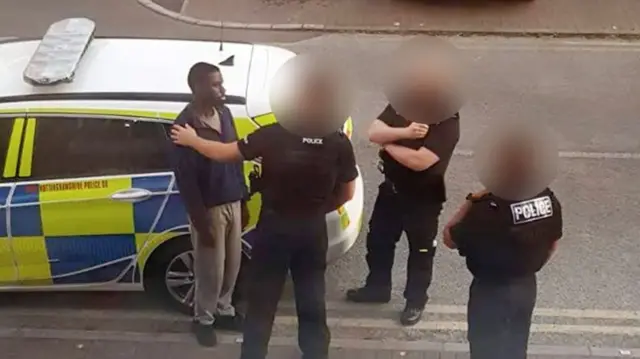
    A man with three police officer surrounding himImage source, Handout
  20. 'Why didn't police ask why Calocane wanted to be arrested?'published at 11:52 GMT 3 March

    Foster is being questioned about why he did not ask Calocane - who is being referred to as VC throughout the inquiry - why he wanted to be arrested.

    He told the inquiry he wanted to "build a rapport to see if [Calocane] was offering any other information", adding he wanted to be "calm and relaxed with VC".

    Foster added Calocane did not display "anything unusual".

    Sophie Cartwright KC, representing the survivors of the Nottingham attacks, asked: "Was it not essential that somebody had to ask VC the question: 'Why have you come to Thames House asking to be arrested?'"

    Foster replied: "I was content with the response that he gave. I was content by his demeanour, his mannerism, he didn't seem agitated. He was calm, compliant and coherent, so I was happy with the response he gave me."